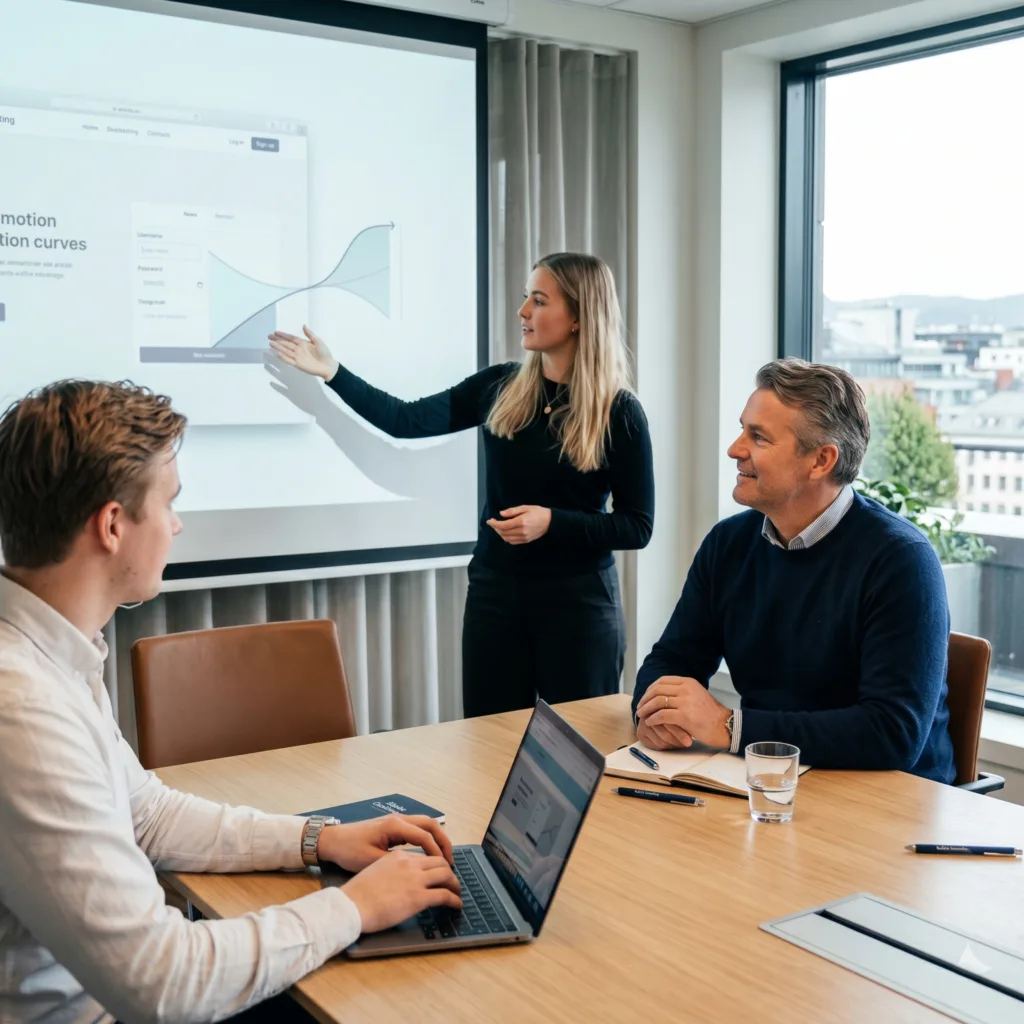
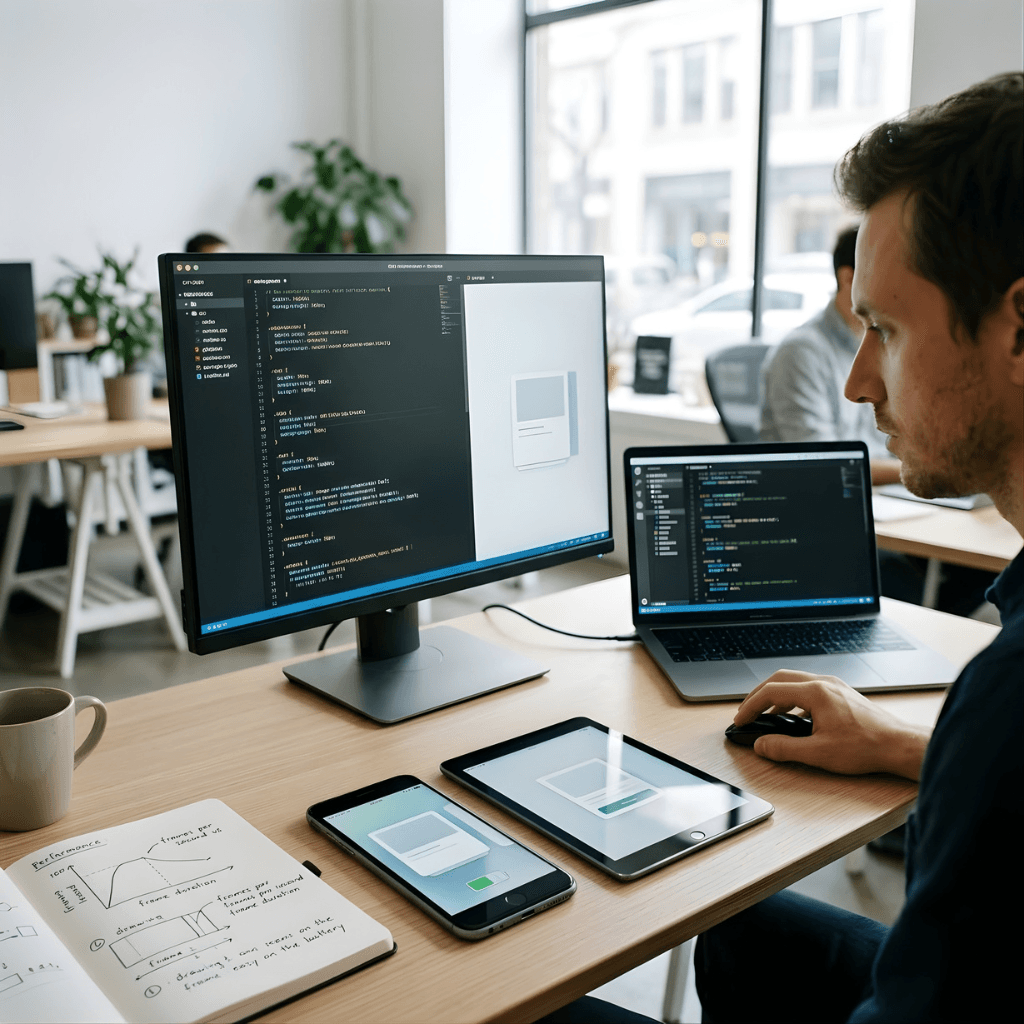
Bring your website to life with professional CSS animations and transitions. vorza360 creates smooth, high-performance visual effects that guide users and make your brand feel modern and interactive.
The Challenge Meryem wanted her luxury brand to feel alive and sophisticated, but she was terrified that adding animations would make the site stutter or feel cheap. She needed a high-end logo reveal and background movement that felt smooth as silk, specifically without any of that annoying jumping or jank that often happens on mobile devices.
The vorza360 Solution We used GPU-accelerated properties, which is like moving the heavy lifting of the animations from the site’s main engine to its specialized graphics card. This ensures everything runs at a silky-smooth 60 frames per second. We built multi-step keyframe stories for her logo reveal, creating a sophisticated sequence that unfolds perfectly. By focusing on specific properties like transform and opacity, we kept the movement fluid without making the phone work too hard.
The Result The background animations are incredibly smooth and the logo reveal perfectly represents her high-end identity. Meryem’s luxury brand now feels alive and premium on every device. Her customers in Bulgaria enjoy a flawless visual experience that looks expensive but runs perfectly on even the most basic smartphones.
Søren Bakke (Norway)
The Challenge Søren felt his navigation menus were too robotic. When someone hovered over a button, it would just pop into a new color instantly, which felt jarring and unfinished. He wanted an invisible quality where every click and hover felt natural, weighted, and responsive, making the entire site feel more premium for his Norwegian clients.
The vorza360 Solution We replaced those instant changes with custom timing functions that mimic how things move in the real world. Instead of a boring, steady speed, we used curves that allow elements to start slow and speed up, or vice versa. We conducted a full motion audit to find the exact spots where a transition would add the most value, ensuring the movement helps the user rather than just being there for show.
The Result The user experience has completely changed. Every interaction now feels natural and high-end, as if the website is actually reacting to the user’s touch. Søren’s site now has that polished, premium feel that sets it apart from the competition, proving that the smallest details often make the biggest difference.
Elena Petrova (Estonia)
The Challenge As a tech startup, Elena was worried that eye-catching animations would destroy her mobile load times and eat up her users’ battery life. She needed to balance high-end visual effects with a strict focus on the latest 2026 web standards. She wanted the site to be exciting but also lightning-fast and respectful of the user’s device.
The vorza360 Solution We followed a strict transform-only rule. This is like only moving the furniture around in a room instead of repainting the walls every time someone walks in; it is much faster and uses way less energy. We built the transitions to be battery-conscious, meaning they automatically stop if a user switches tabs or moves away. This keeps the site lightweight and ensures she maintains top-tier performance scores.
The Result The site is lightning-fast and visually stunning. Elena has successfully balanced interactive effects with high-speed performance. Her tech startup in Estonia now has a modern, energetic digital home that looks great and passes every technical speed test with flying colors.
Alistair Vance (United Kingdom)
The Challenge Alistair wanted to use animations to guide his users through his sales funnel more effectively. He was worried about jumping into coding without a clear plan, and he needed to be 100 percent sure that even customers on older smartphones would have a smooth, stutter-free experience with the interactive buttons and scroll effects.
The vorza360 Solution We started with a storyboarding phase, which is like drawing a comic book of the website’s movement before we write a single line of code. This allowed Alistair to visualize the flow and make changes early on. We then put the final animations through a device stress-test, pushing them to the limit on older hardware to ensure they remained smooth and professional for every single visitor.
The Result The polished scroll effects and interactive buttons now guide users perfectly through the site. Alistair has seen better engagement in his sales funnel, and the stutter-free experience on all devices has given him total confidence. His UK business is now powered by a smooth, interactive journey that feels intentionally designed.
Javier Montoya (Mexico)
The Challenge Javier’s website felt robotic and stiff. He wanted a fluid, professional platform where the interface felt intuitive. He was worried that having multiple moving parts would lead to lag, which would increase his bounce rates and make people leave the site out of frustration. He needed a zero-lag guarantee for his Mexican market.
The vorza360 Solution We focused on easing calibration, which ensures that elements accelerate and decelerate just like objects do in real life. It is the difference between a sliding door and a slamming one. We optimized every moving part to ensure there is no lag, keeping the page speed at the top of its class. This makes the interface feel like a natural extension of the user’s hand rather than a distracting technical gimmick.
The Result The robotic feel is gone, replaced by a fluid and professional platform. Javier has seen a decrease in bounce rates because the site is so satisfying to use. Despite having many moving parts, the site stays fast and responsive, giving his brand a high-tech edge in the local market.
Anaya Bashir (Pakistan)
The Challenge Anaya has a complex web app that processes a lot of data, and she needed a way to make it feel more interactive and less like a static spreadsheet. She wanted loading spinners and page transitions that would give her users helpful feedback and keep them engaged while they waited for their tasks to be completed.
The vorza360 Solution We integrated lightweight transitions and custom loading spinners that provide excellent visual feedback. Instead of using motion just for flash, we prioritized the user’s journey. These transitions tell the user exactly what is happening like a little nod of the head, which makes the data processing feel faster and more interactive. It’s motion with a purpose, designed to help users finish their work more efficiently.
The Result The app feels much more interactive and user-friendly. Anaya’s customers in Pakistan now have a clear understanding of what the app is doing at all times, which has improved their overall satisfaction. She has a professional tool that uses motion to solve problems, making a complex task feel simple and engaging.
vorza360’s Tech Edge
Keyframe Animations
Transition Effects
Transform Properties
+ 2
More
Timing Functions
Performance-Friendly Animations
vorza360’s Tech Edge
Keyframe Animations
We use keyframes to build complex, multi-step stories. Whether it’s a logo that assembles itself or a moving background, we control every frame of the animation CSS transition.
Transition Effects
Perfect for buttons and menus. We ensure that when a user hovers or clicks, the change feels natural and professional, not instant or jarring.
Transform Properties
To keep things fast, we focus on transform and opacity. This moves the “work” to the device’s GPU, resulting in CSS animations and transitions that run at a silky-smooth 60 frames per second.
Timing Functions
We don’t use “robotic” movement. Using custom cubic-bezier curves, we mimic real-world physics so your elements accelerate and decelerate like actual objects.
Performance-Friendly Animations
vorza360 follows the “Transform-Only” rule. We avoid animating properties like width or top which can cause “jank” (stuttering) on mobile devices.
How we do it
vorza360 blends physics and design to create movement that feels natural and premium.
Creative Approaches
We focus on “Tiny Joys.” Instead of big, distracting movements, we add small animation CSS transition effects to buttons and icons. These gentle fades give users instant feedback, making your site feel high-quality and well-made.
Insightful Strategies
We use “Smart Guidance.” We use CSS animations and transitions to lead the eye to important areas. By making a button pulse softly or a title slide in with an animated transition CSS effect, we help you get more clicks naturally.
Tailored Solutions
We stop “Choppy Motion” on all screens. Whether it’s a CSS transition with animation or a simple hover effect, we write code that is easy on the battery. This ensures your CSS transition animation stays smooth on both old phones and new computers.
Creative Approaches
We focus on “Tiny Joys.” Instead of big, distracting movements, we add small animation CSS transition effects to buttons and icons. These gentle fades give users instant feedback, making your site feel high-quality and well-made.
Insightful Strategies
We use “Smart Guidance.” We use CSS animations and transitions to lead the eye to important areas. By making a button pulse softly or a title slide in with an animated transition CSS effect, we help you get more clicks naturally.
Tailored Solutions
We stop “Choppy Motion” on all screens. Whether it’s a CSS transition with animation or a simple hover effect, we write code that is easy on the battery. This ensures your CSS transition animation stays smooth on both old phones and new computers.
Our Service Cycle
vorza360 follows a clear path to add “soul” to your website through motion.
Step 1
Motion Audit
Step 2
Storyboarding
Step 3
Lightweight Coding
Step 4
Easing Calibration
Step 5
Device Stress-Test
Step 6
SEO & Speed Polish
Step 1
Motion Audit
We identify which parts of your site would benefit most from a CSS transition with animation.
Step 2
Storyboarding
vorza360 sketches out the timing and flow of complex CSS animations and transitions.
Step 3
Lightweight Coding
We write “GPU-accelerated” code to ensure the animation CSS transition never lags.
Step 4
Easing Calibration
We fine-tune the timing functions to make every movement feel natural and smooth.
Step 5
Device Stress-Test
We test your CSS transition animation effects on old phones to ensure they don’t stutter.
Step 6
SEO & Speed Polish
We verify that your animations don’t hurt your “Core Web Vitals” scores or page speed.
Why Choose vorza360 for This Service?
vorza360 provides “Invisible” quality, the kind of smooth motion users feel but never struggle with.
Zero-Lag Guarantee
By specializing in animate transition CSS techniques that use hardware acceleration, we ensure your site stays fast even with many moving parts.
UX-Focused Design
We don’t just add “flashy” effects. Our CSS animations and transitions are designed to help users finish tasks faster and enjoy their time on your site.
Battery Conscious
We use modern browser tools to ensure your animation CSS transition stops running when the user switches tabs, saving their device’s energy.
Here is what our Clients are saying About us
James Harrington (United Kingdom)
vorza360 implemented CSS animations and transitions for our web platform that enhance the user experience without harming performance. Animations that feel purposeful rather than decorative.
Mariam Al-Harthi (Bahrain)
vorza360 developed CSS animations for our brand website that bring our visual identity to life on screen. Animation quality that our creative director approved on first review.
Alexandru Vasile (Romania)
vorza360 built CSS transitions for our web application’s interactive elements, menus, modals, and state changes, that give our UI the polish our users expect.
Sneha Menon (India)
vorza360 implemented CSS animations for our onboarding flow that guide new users through our product. Purposeful animation that communicates rather than distracts.
Daniel Park (South Korea)
vorza360 developed CSS keyframe animations for our marketing website with scroll-triggered effects and the visual dynamism our brand’s web presence requires.
Fatima Al-Sayed (Nigeria)
vorza360 built CSS transitions for our web application that work smoothly even on the lower-specification devices our users have.
More about CSS3 Development
CSS3 Development
Transform your website into a visual masterpiece with professional CSS3 development…
Got questions? We’ve got answers. Find everything you need to know about using our platform, plans, and features
What is the difference between CSS transitions and CSS animations, and when does vorza360 use each?
CSS transitions are simple, reactive effects that interpolate a property from one value to another in response to a state change, such as a button’s background colour smoothly changing from blue to dark blue when hovered, or an element fading in when a class is added. CSS animations are more powerful and self-contained, defined by keyframes that specify multiple states along the animation’s timeline, they can run automatically on load, loop, and alternate direction without requiring a state trigger. vorza360 uses transitions for interactive feedback effects (hover states, focus styles, toggles, dropdown reveals) and CSS animations for entrance animations, loading indicators, background motion, and any effect that has its own lifecycle independent of user interaction.
How does vorza360 ensure CSS animations are smooth and do not cause performance issues?
CSS animation performance depends critically on which CSS properties are animated. Animating properties like width, height, top, left, margin, or padding triggers layout recalculations on every frame, an expensive operation that causes jank (visible stuttering) particularly on mobile devices. vorza360 follows the GPU-acceleration principle: we animate only transform (translate, scale, rotate) and opacity, which the browser can hand off to the GPU compositor thread and render without involving the CPU layout engine. This produces silky-smooth 60fps animations even on mid-range mobile hardware. We use will-change: transform sparingly on elements that will animate to hint the browser to create a compositor layer in advance. We also verify animations do not drop frame rates using Chrome DevTools’ Performance panel before delivery.
How does vorza360 implement page entrance and scroll-triggered animations using CSS?
Entrance animations, elements that fade, slide, or scale into view as the page loads or as the user scrolls, add visual polish and help guide users through page content sequentially. vorza360 implements scroll-triggered animations using the Intersection Observer API in JavaScript to add a CSS class when an element enters the viewport, triggering a pre-defined CSS animation or transition. The CSS animation is defined in the stylesheet with prefers-reduced-motion handling, and JavaScript only controls the class toggle, keeping the animation logic in CSS where it belongs and the JavaScript minimal. For page load entrance animations, we use CSS animation-delay to stagger the appearance of multiple elements, creating a sense of sequential narrative rather than everything appearing simultaneously.
How does vorza360 respect users with motion sensitivity when implementing CSS animations?
The prefers-reduced-motion media query allows users to signal through their operating system’s accessibility settings that they are sensitive to motion, a condition relevant to users with vestibular disorders, epilepsy, or general discomfort with animated interfaces. vorza360 implements prefers-reduced-motion handling as a standard practice in every CSS animation and transition we write. Inside the @media (prefers-reduced-motion: reduce) query block, we either disable animations entirely, reduce them to simple opacity fades that convey the same information without spatial movement, or remove them completely. This ensures your website is accessible to users who have opted out of motion without removing the animation experience for users who enjoy it.
Can vorza360 create complex, multi-step animations entirely in CSS without JavaScript?
Yes, CSS keyframe animations are remarkably powerful and can express complex, multi-step motion sequences entirely without JavaScript. vorza360 uses @keyframes to define named animation sequences with as many states as needed, controlling position, opacity, scale, rotation, colour, and more at arbitrary points along the timeline. We use animation-timing-function with custom cubic-bezier curves to create physics-like easing that makes movement feel natural rather than robotic. We use animation-delay to sequence multiple animations. We use animation-iteration-count: infinite for looping effects like loading spinners and pulsing indicators. For coordinated multi-element animations, we orchestrate timing using staggered delays, all within pure CSS, with no JavaScript dependency and therefore no performance overhead from script execution.