vorza360 is an expert IoT development company, specializing in embedded and IoT software development that connect physical devices to the cloud. We create reliable, low-power IoT embedded software for smart devices, ensuring secure data transfer, real-time control, and seamless operation.
The Challenge: Wolfgang’s industrial equipment company had a product line of precision manufacturing machines that customers managed with manual monitoring and scheduled maintenance. Machines were serviced on fixed schedules regardless of actual condition, and unplanned failures were common between service visits. He wanted to add remote monitoring to the product line but had no IoT development capability in-house.
The vorza360 Solution: We developed embedded software for Wolfgang’s machines that collected operational data, vibration, temperature, power consumption, cycle counts, and transmitted it to a cloud platform where machine learning models identified patterns that preceded failures. A customer-facing dashboard showed machine health and flagged conditions requiring attention.
The Result: Customers moved from scheduled maintenance to condition-based maintenance, reducing unnecessary service visits and catching developing issues before failure. Wolfgang’s service team could see the condition of every installed machine remotely, and unplanned customer callouts dropped significantly as issues were identified and scheduled proactively.
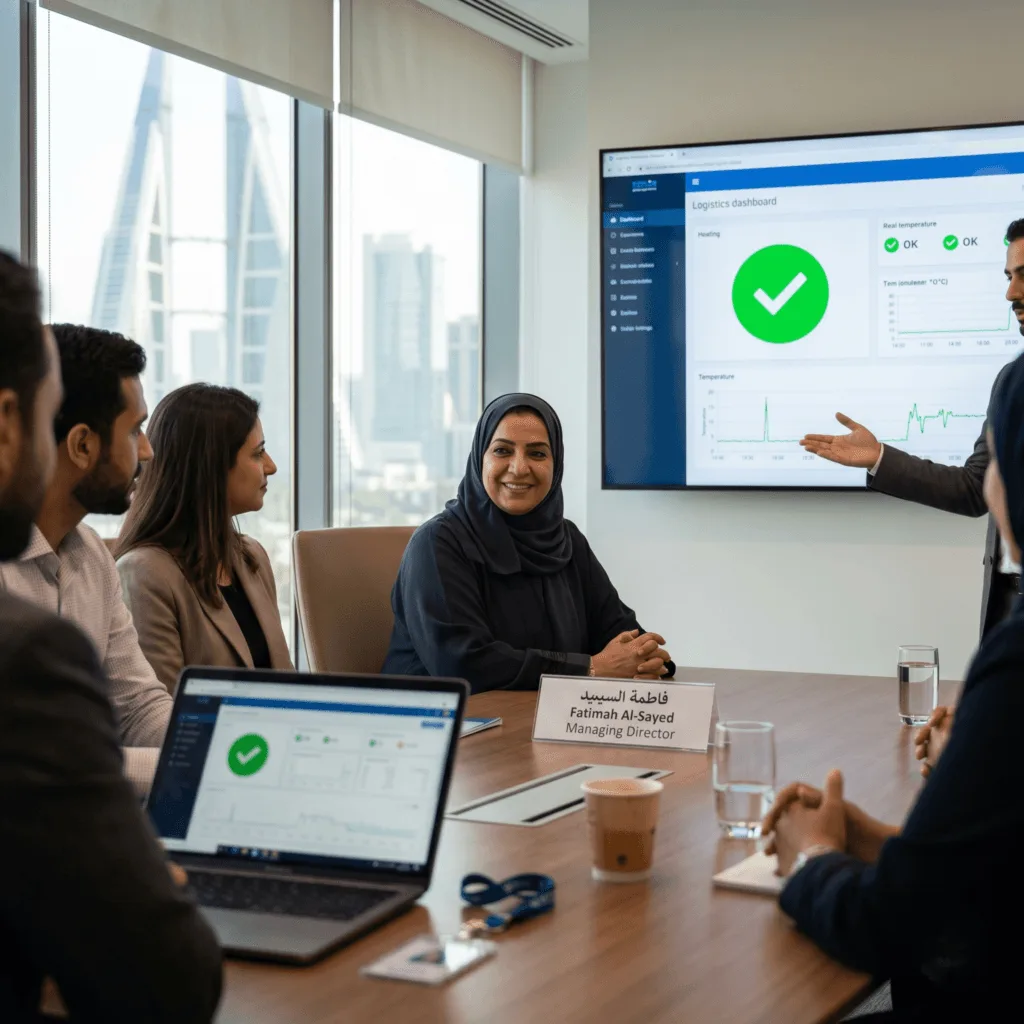
Fatimah Al-Sayed (Bahrain)
The Challenge: Fatimah’s cold chain logistics company transported temperature-sensitive medical supplies. Temperature monitoring during transit was done with data loggers that were read manually at the destination, meaning temperature excursions were only discovered after delivery, when remediation was impossible. Regulatory requirements were becoming stricter about continuous temperature evidence.
The vorza360 Solution: We developed IoT temperature monitoring hardware integration and the software platform to receive, store, and alert on temperature data in real time during transit. Temperature data was recorded continuously, visible to operations staff in real time, and alerts triggered automatically when thresholds were exceeded so remediation could happen during transit rather than after delivery.
The Result: Fatimah’s team could intervene during temperature excursions rather than discovering them at the destination. The continuous temperature records met the strengthened regulatory requirements without any additional manual effort. Several medical supply clients specifically cited the real-time monitoring capability as a reason for awarding contracts, as it provided the evidence chain their own compliance required.
Alexandru Marin (Romania)
The Challenge: Alexandru’s smart building company was installing environmental control systems in commercial buildings, HVAC, lighting, access control, but each system had separate controls and separate software. Building managers had to use multiple interfaces to manage their building, and integrating data across systems to identify efficiency improvements was impossible.
The vorza360 Solution: We developed an IoT integration layer and unified building management software that connected all of Alexandru’s systems through a single platform. Building managers had one interface for all systems, and the integrated data enabled cross-system analysis, identifying, for example, how occupancy patterns from access control could inform HVAC scheduling.
The Result: Building managers adopted the unified platform enthusiastically because the single interface simplified their daily work. The cross-system analysis identified energy efficiency improvements that none of the standalone systems could have found individually. Alexandru’s smart building offering became meaningfully differentiated from competitors offering the same underlying hardware with separate control systems.
Arjun Pillai (India)
The Challenge: Arjun’s agricultural technology company wanted to give smallholder farmers access to IoT soil and weather sensors to improve irrigation and crop management decisions. The challenge was the hardware cost, connectivity in rural areas, and making the software simple enough for farmers with limited technical experience to use via low-end smartphones.
The vorza360 Solution: We developed embedded firmware for the sensors that operated efficiently on low-power hardware, transmitted over low-bandwidth connections when available, and stored data locally when connectivity was absent. The farmer-facing application was designed for low-spec Android devices with an interface that relied on visual indicators rather than complex data displays.
The Result: Arjun’s sensors were deployed across hundreds of farms. The offline capability meant connectivity gaps didn’t lose data. Farmers who had never used agricultural technology before adopted the application because the interface presented actionable recommendations, irrigate today, likely rain tomorrow, rather than raw sensor data that required interpretation.
Erik Holm (Norway)
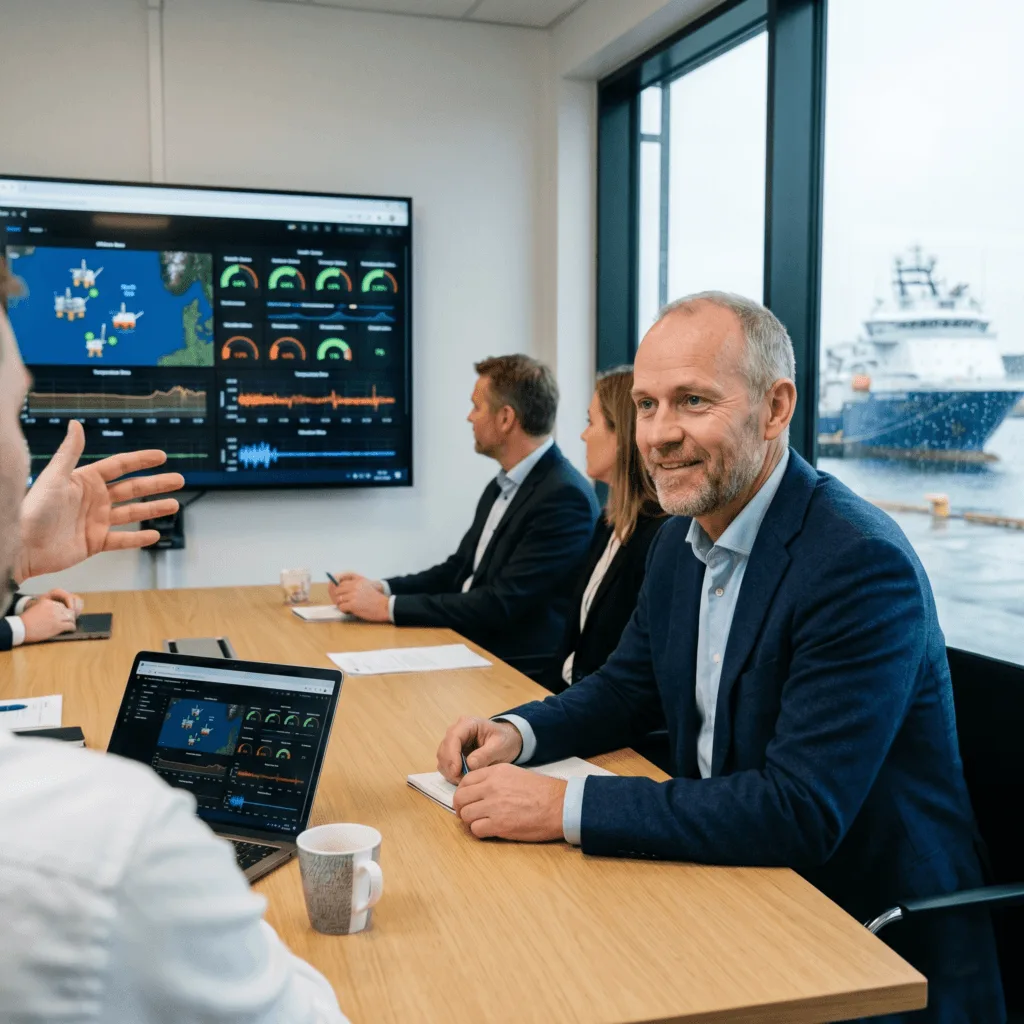
The Challenge: Erik’s offshore energy company had remote installations that were inspected by human teams on fixed schedules, expensive, logistics-intensive, and limited in frequency by the cost and safety complexity of offshore access. He wanted to move to continuous automated monitoring but had concerns about the reliability of software in harsh marine environments.
The vorza360 Solution: We developed embedded monitoring software designed specifically for harsh environment reliability, fault-tolerant operation that continued functioning through power fluctuations, redundant communication paths for data transmission, and alert logic that distinguished genuine anomalies from sensor noise. The platform aggregated data from all installations into a central monitoring dashboard.
The Result: Erik’s inspection schedule was restructured, routine scheduled inspections were reduced in frequency, with inspections triggered by actual conditions rather than the calendar. The continuous monitoring data identified developing issues that scheduled inspection would have missed between visits. The reduction in routine inspection logistics costs partially offset the development investment within the first year.
Abiodun Oladele (Nigeria)
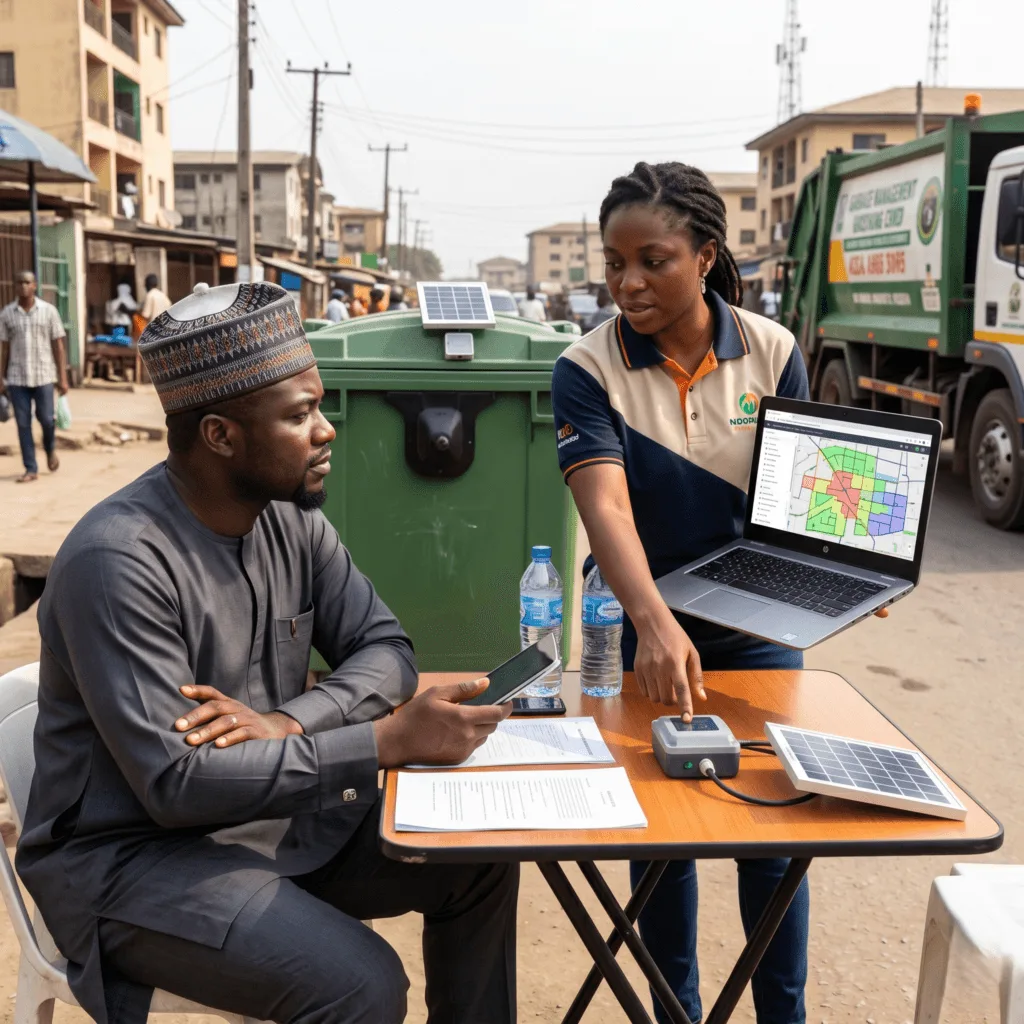
The Challenge: Abiodun’s waste management company had a fleet of collection vehicles and hundreds of waste collection points across a city. Route planning was based on fixed schedules, many vehicles made collections at bins that were barely used while others missed bins that were overflowing. He wanted smart bin monitoring but needed it to work in an environment where connectivity was patchy and power supply at collection points was unreliable.
The vorza360 Solution: We developed solar-powered IoT sensors for collection bins with embedded software optimised for intermittent connectivity, transmitting data when available and storing locally when not. The route optimisation software used fill-level data to generate dynamic collection routes that prioritised bins approaching capacity rather than following fixed schedules.
The Result: Collection efficiency improved as vehicles stopped making unnecessary trips to empty bins and started prioritising bins that needed collection. Overflowing bins, the most visible quality metric for Abiodun’s municipal clients, dropped significantly. The solar power and intermittent connectivity design meant the solution worked in the actual environment rather than requiring infrastructure improvements that would have been impractical.
How we do it
Our process covers the entire journey, from low-level device code to high-level cloud connectivity and user apps.
Hardware-Software Co-Design
We start by planning the software alongside the device hardware. We define the functions of the IoT embedded software and choose the right processor and low-power tools.
Firmware and Cloud Connection
Next, we write the device code and set up its network links. We create the firmware that controls the sensors and hardware. We establish secure protocols (like MQTT) for the device to send data reliably to the cloud.
App and Deployment
Finally, we build the user interfaces and launch the complete system. We develop mobile or web applications for users to control devices and view data. We deploy the entire system and plan for future Over-The-Air (OTA) updates.
Hardware-Software Co-Design
We start by planning the software alongside the device hardware. We define the functions of the IoT embedded software and choose the right processor and low-power tools.
Firmware and Cloud Connection
Next, we write the device code and set up its network links. We create the firmware that controls the sensors and hardware. We establish secure protocols (like MQTT) for the device to send data reliably to the cloud.
App and Deployment
Finally, we build the user interfaces and launch the complete system. We develop mobile or web applications for users to control devices and view data. We deploy the entire system and plan for future Over-The-Air (OTA) updates.
Tools
Key Tools vorza360 Offers
PlatformIO
A cross-platform tool used for coding, building, and debugging firmware across many different processor boards.
Keil MDK (Microcontroller Development Kit)
A professional, comprehensive tool suite used for developing and optimizing code on ARM-based microcontrollers.
JTAG/SWD Debuggers
Hardware tools used to directly connect to the device chip to find and fix bugs in the running code instantly.
Wireshark
A network analysis tool used to check and verify the data packets being sent securely between the device and the cloud.
Platform Support for Connectivity
We ensure your devices can connect, store data, and be managed securely by major cloud providers.
AWS IoT Core
Amazon’s cloud service for connecting billions of devices securely and routing their data to other services
Microsoft Azure IoT Hub
Microsoft’s managed service for bi-directional communication between millions of IoT devices and the Azure cloud.
Google Cloud IoT Core
Google’s tool for connecting, managing, and taking in data from globally spread devices.
FreeRTOS
A leading operating system specifically designed to run on small microcontrollers with very low memory and power.
Linux (Embedded/Yocto)
Used for more powerful IoT development edge devices that require a full operating system for complex tasks.
Edge/Gateway Devices
Specialized hardware that processes data locally (at the “edge”) before sending only necessary information to the cloud.
AWS IoT Core
Amazon’s cloud service for connecting billions of devices securely and routing their data to other services
Microsoft Azure IoT Hub
Microsoft’s managed service for bi-directional communication between millions of IoT devices and the Azure cloud.
Google Cloud IoT Core
Google’s tool for connecting, managing, and taking in data from globally spread devices.
FreeRTOS
A leading operating system specifically designed to run on small microcontrollers with very low memory and power.
Linux (Embedded/Yocto)
Used for more powerful IoT development edge devices that require a full operating system for complex tasks.
Edge/Gateway Devices
Specialized hardware that processes data locally (at the “edge”) before sending only necessary information to the cloud.
Core Development Frameworks
We use specialized frameworks to build high-quality, high-speed applications on and off the device.
Embedded C/C++
The primary low-level language for firmware, offering precise hardware control and fast performance.
Python (MicroPython)
A small version of Python used on microcontrollers for faster prototyping and easier coding.
Arm Mbed OS
An operating system and development toolkit designed for building internet-connected, power-efficient devices.
Node-RED
A visual tool for easily wiring together hardware, APIs, and online services using drag-and-drop programming.
MQTT (Messaging Protocol)
The lightweight data protocol that makes device-to-cloud communication fast and uses very little capacity.
CoAP (Constrained Application Protocol)
A simple web transfer protocol used for very small, power-restricted IoT software devices.
React Native/Flutter
Frameworks used for quickly building the mobile applications that serve as the user’s interface to the IoT device.
Jenkins/GitLab CI (CI/CD)
Tools used to automatically test and build the device firmware and cloud code consistently and reliably.
Custom Headless Development
We are an eCommerce website design company, that uses the best creative skills to meet your business needs and ensure customer satisfaction. We’re with you every step of the way, from the beginning of your project to its completion.
Fashion & Apparel
Food & Grocery
Retail
FMCG
Real Estate
Construction
Hotel
Healthcare
Telecom
Fintech
Manufacturing
Automotive
Our IoT Development Cycle
Our systematic approach ensures quality and reliability across both the hardware and software components.
Step 1
Requirement & Strategy
Step 2
Hardware Design & Prototype
Step 3
Firmware Development
Step 4
Cloud & App Integration
Step 5
Rigorous Testing & Validation
Step 6
Deployment & OTA Maintenance
Step 1
Requirement & Strategy
Defining all software features, hardware needs, and security goals for the embedded and IoT services.
Step 2
Hardware Design & Prototype
Choosing the processor and components, and building a basic working model to test the idea.
Step 3
Firmware Development
Writing the core low-level code that directly controls the sensors and actuators on the device.
Step 4
Cloud & App Integration
Developing the server logic and mobile/web apps, and connecting them securely to the device.
Step 5
Rigorous Testing & Validation
Stress testing the device and cloud system for performance, security, and battery life.
Step 6
Deployment & OTA Maintenance
Launching the system and setting up Over-The-Air (OTA) updates for future fixes and feature additions.
Here is what our Clients are saying About us
Thomas Becker (Germany)
vorza360 developed embedded software for our industrial equipment that handles real-time control, sensor data processing, and remote diagnostics. The reliability requirements of embedded software in industrial environments are unforgiving, vorza360 delivered to that standard.
Tariq Al-Zahrani (UAE)
vorza360 built IoT firmware for our smart building sensor network with efficient power management, reliable connectivity, and secure over-the-air update capability.
Alexandru Dumitru (Romania)
vorza360 developed IoT software for our fleet tracking system, device firmware, gateway software, and cloud backend, as a complete solution. The full-stack IoT capability vorza360 brought avoided the integration complexity of combining separate specialists.
Arjun Kapoor (India)
vorza360 built embedded software for our medical device meeting the regulatory requirements for software in medical devices. The documentation, testing, and validation processes satisfied our regulatory submission.
Siti Rahayu (Malaysia)
vorza360 developed IoT software for our agricultural monitoring system that processes sensor data at the edge and transmits only relevant events to reduce connectivity costs. Designed for the constrained connectivity of agricultural deployments.
Adaeze Obi (Nigeria)
vorza360 built embedded software for our point-of-sale hardware that handles payment processing, receipt printing, and inventory integration reliably in demanding retail environments.
More about Software
Custom Software Development
vorza360 is a leading custom software development company, providing end-to-end…
Got questions? We’ve got answers. Find everything you need to know about using our platform, plans, and features
What embedded and IoT software development services does vorza360 offer?
vorza360 delivers full embedded and IoT software development through a six-stage lifecycle: Requirement & Strategy (defining software features, hardware needs, and security goals), Hardware Design & Prototype (selecting the processor and components and building a proof-of-concept device), Firmware Development (writing the core low-level code in Embedded C/C++ that controls sensors and actuators), Cloud & App Integration (developing the server-side logic, mobile or web apps, and connecting them securely to the device using MQTT, CoAP, or cellular protocols), Rigorous Testing & Validation (stress testing device and cloud systems for performance, security, and battery life), and Deployment & OTA Maintenance (launching the system and establishing Over-the-Air update infrastructure for future fixes and feature additions). Cloud backends are built on AWS IoT, Azure IoT Hub, or GCP IoT Core.
What communication protocols does vorza360 use for IoT devices, and how are they chosen?
vorza360 selects IoT communication protocols based on each device category’s specific requirements: MQTT (Message Queuing Telemetry Transport) for lightweight, reliable messaging between sensors and cloud backends over IP networks, the most widely used IoT protocol for standard industrial and commercial applications; CoAP (Constrained Application Protocol) for extremely resource-constrained devices on low-bandwidth networks; Zigbee and Z-Wave for short-range, low-power mesh networks in smart building environments; LoRaWAN for long-range, low-power wide-area deployments (sensors spread across a large campus, agricultural land, or remote locations where Wi-Fi and cellular are unavailable or impractical); and cellular (4G/5G with best IoT SIM multi-network support) for mobile or geographically isolated devices. The right choice depends on communication range, power constraints, data rate requirements, device density, and existing infrastructure.
How does vorza360 ensure embedded and IoT software is secure?
IoT security requires a different approach from application security because devices have limited processing power, often run in unmonitored environments, and may stay deployed for years without physical access for maintenance. vorza360’s IoT security framework addresses all major threat vectors: Secure Boot to verify that only authenticated firmware runs on the device, encrypted communications using TLS for all device-to-cloud data transmission, device identity certificates (X.509) for authenticated device registration with cloud IoT platforms, Over-the-Air (OTA) update signing to prevent malicious firmware injection, network segmentation to isolate IoT devices on dedicated VLANs, and regular security audits using network analysis tools like Wireshark to validate that data packets are encrypted and well-formed. For healthcare and industrial IoT, we apply additional security layers aligned to industry-specific standards (IEC 62443 for industrial systems, HIPAA for medical devices).
What cloud platforms does vorza360 use for IoT backend infrastructure?
vorza360 builds IoT cloud backends on all three major cloud IoT platforms, selecting based on scale, existing infrastructure, and specific service requirements: AWS IoT Core (Amazon’s cloud IoT service for connecting billions of devices securely, routing their data to AWS services, and managing device shadows for bi-directional state management, recommended for large-scale deployments and organizations already on AWS), Microsoft Azure IoT Hub (Microsoft’s managed service for bi-directional device-to-cloud communication with deep integration into Azure Digital Twins for asset modeling, recommended for enterprise IoT and organizations in the Microsoft ecosystem), and Google Cloud IoT Core (optimized for data analytics-heavy IoT deployments leveraging BigQuery and Pub/Sub, recommended for applications requiring real-time stream processing of large sensor data volumes). Edge processing is supported through AWS Greengrass, Azure IoT Edge, and EdgeX Foundry for applications requiring local computation.
Can vorza360 build mobile or web apps for users to interact with IoT devices?
Yes, a user-facing mobile or web application is a standard component of every vorza360 IoT engagement. The mobile app (built with React Native or Flutter for iOS and Android from a single codebase) serves as the user interface to the IoT system: displaying real-time sensor data and device status, providing controls for device settings and commands, sending push notifications when devices trigger alerts or thresholds, showing historical data analytics and trend charts, and managing device provisioning and configuration. The web dashboard provides a more detailed operational view for administrators: fleet management across all deployed devices, firmware version tracking, OTA update management, advanced analytics and reporting, and user permission management. Both the mobile app and web dashboard communicate with the same cloud backend IoT infrastructure, ensuring consistent data and a unified management experience across all interfaces.