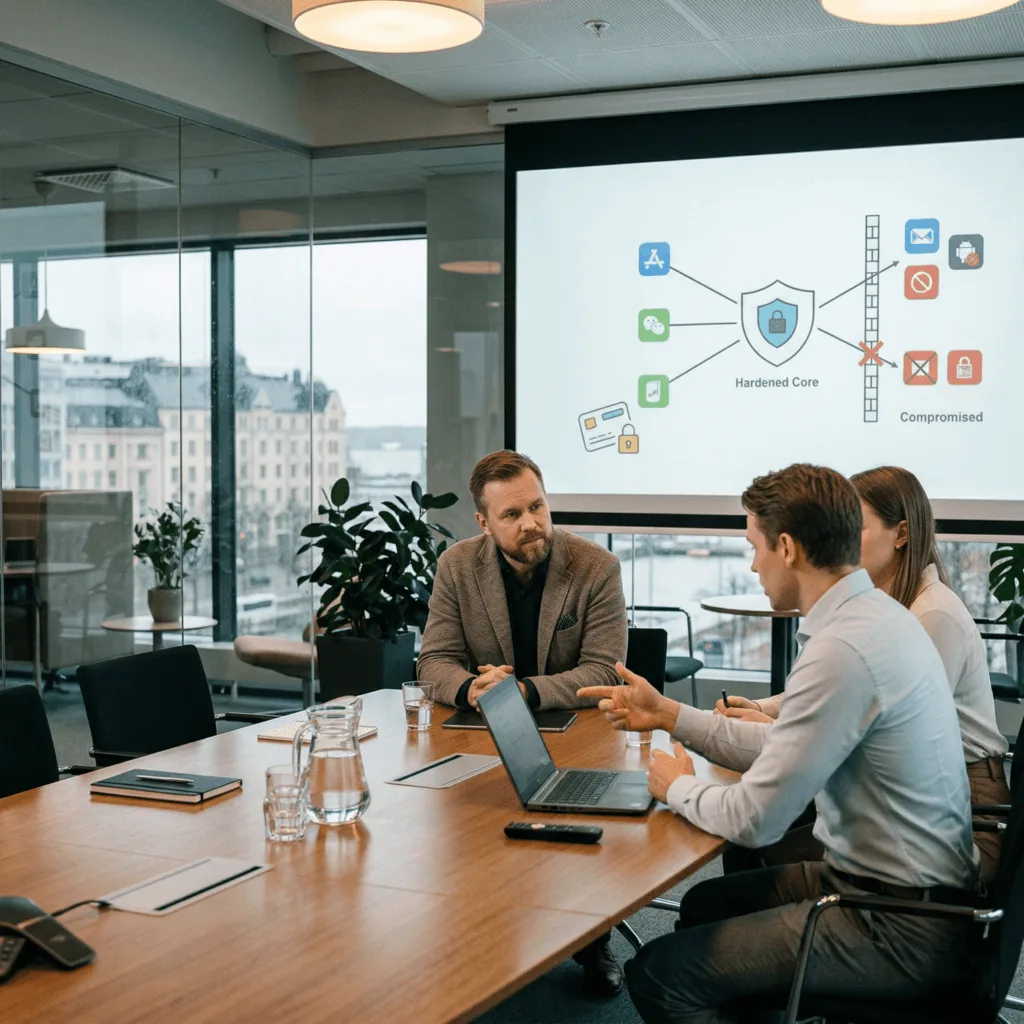
Keep your business safe from digital threats with vorza360’s expert Linux security and hardening services. We build a powerful shield around your data to ensure your servers stay protected and reliable.
The Challenge Annika was worried about “brute-force” attacks where hackers try thousands of passwords to break into a server. Her current setup used standard login methods that felt risky, and she needed to lock her server’s front door properly. She wanted a professional way to ensure that only her trusted team could get in, without making the login process a nightmare for her staff in Sweden.
The vorza360 Solution We implemented a secure SSH configuration that completely blocks risky password logins. Instead, we issued high-security digital keys that act like a sophisticated physical key that cannot be copied. We also set up “rules of the house” using mandatory access control, so even if someone got inside, they couldn’t touch anything they weren’t supposed to. It is like replacing a standard door lock with a high-end biometric scanner, it is much harder to break, but just as easy for the right people to use.
The Result The risky login attempts dropped to zero almost immediately. Annika’s team can work smoothly, and she feels much safer knowing her “digital front door” is locked tight. She appreciates that we built a defense that matches her team’s workflow perfectly.
Lukas Vanagas (Lithuania)
The Challenge Lukas had a server full of sensitive customer data and was terrified of a “silent” break-in where a hacker might hide inside the system for weeks. He needed a way to spot suspicious movement the second it happened. He was looking for a partner who would install smart alarms and keep a constant watch on his most important files for any unauthorized changes.
The vorza360 Solution We installed a professional intrusion detection setup and file integrity monitoring. This system takes a “digital fingerprint” of his important files; if even a single letter is changed without permission, an alarm goes off and notifies our team instantly. We also automated his daily safety checks using a custom Linux security hardening script. It is like having a bank vault equipped with motion sensors and weight-sensitive floors, the moment something is out of place, the sirens scream and the guards are on the way.
The Result Lukas now has 24/7 peace of mind. He knows that his system is being watched by experts who live and breathe Linux security. His site stability is at an all-time high, and he no longer worries about hidden threats lurking in his code.
Kofi Mensah (Ghana)
The Challenge Kofi’s office network had several “open Windows”, unused digital paths that hackers could potentially use to get inside. He needed a full network shielding plan that would close these paths and set up a powerful firewall to stop unwanted internet traffic. He was looking for a tailored solution that would match his specific hardware needs in Ghana without slowing down his team’s connection.
The vorza360 Solution We performed a full safety audit to find every vulnerability in his network. We closed every unused path and wrapped his system in protective layers using a security baseline enforcement strategy. We adjusted every setting to match his hardware perfectly, ensuring the firewall blocks the bad guys but lets his employees work with total speed. It is like putting high-quality security film on every window of a building, it doesn’t block the view or the light, but it makes the glass almost impossible to break.
The Result The network is now a safe haven for Kofi’s business data. He has a professional shield around his data that doesn’t interfere with his daily operations. He appreciates that vorza360 is a service provider that stays by his side to keep the hardening strong as new threats emerge.
Amara Okeeke (Nigeria)
The Challenge Amara’s business uses small, smart devices (embedded Linux) to track inventory, and he was worried these “small” points could be a “big” entry point for hackers. He needed specialized embedded Linux security hardening that wouldn’t overwhelm the limited power of these tiny devices. He wanted a partner who could think like an attacker and find the weak spots in his unique setup.
The vorza360 Solution We customized a security plan specifically for his small devices, applying strict access controls and hardening the core of the system. We made sure that even on smaller hardware, the security is “always active” and follows proven safety standards. It is like giving a small delivery drone the same level of armored protection as a bank truck, it is still light and fast, but it is incredibly tough to mess with.
The Result Amara’s entire inventory network is now secure. He no longer worries about his smart devices being the “weak link” in his company’s security. He values the technical “scary stuff” we handle, allowing him to focus on his customers and his UK-wide growth.
Priyanka Nair (India)
The Challenge Priyanka knew that security isn’t a one-time job, but she didn’t have the time to keep up with the latest digital risks. She needed a long-term security partner who would provide ongoing updates and regular checks to keep her Linux server security hardening at peak performance. She wanted a service, not just a software tool that she would have to manage herself.
The vorza360 Solution We act as Priyanka’s long-term security partners, providing continuous care for her servers. We follow a professional service cycle that includes regular safety audits and manual hardening of her systems as new threats appear. We set up tools that notify our team of any weird activity, so we can react before a problem even starts. It is like having a world-class security firm on a permanent retainer, they don’t just install the cameras; they stay in the control room every night to make sure you are safe.
The Result Priyanka can sleep better knowing her business is protected by experts who care. Her digital environment remains a safe place to work, and she has a solid foundation for her 2026 digital strategy in India. She loves that vorza360 is a service-first company that stays by her side.
Elmo Järvinen (Finland)
The Challenge Elmo needed to implement strict rules for how his applications interacted with his data. He wanted to ensure that if one app was compromised, it couldn’t spread to the rest of the system. He needed to “harden the core” of his Linux OS using advanced tools like SELinux to keep his most private information limited to only those who truly need it.
The vorza360 Solution We implemented mandatory access control to set strict “rules of the house” for every application on his server. We wrapped the system in protective layers that prevent apps from touching anything outside of their specific job. We also set up constant watching tools to notify us of any attempt to break these rules. It is like having a high-security office where every employee’s keycard only opens the specific doors they need for their work, preventing anyone from wandering into the private records room.
The Result Elmo’s system is now incredibly resilient. The core of his server is hardened against modern threats, and his data is more organized and secure than ever. He sees vorza360 not just as a service provider, but as a guardian of his digital presence in Finland.
vorza360’s Tech Edge
Mandatory Access Control (SELinux/AppArmor)
Secure SSH Configuration
Intrusion Detection Setup
+ 2
More
File Integrity Monitoring
Security Baseline Enforcement
vorza360’s Tech Edge
Mandatory Access Control (SELinux/AppArmor)
We set strict “rules of the house” so that apps only touch what they are supposed to.
Secure SSH Configuration
We lock your server’s front door by using high-security keys and blocking risky login methods.
Intrusion Detection Setup
We install smart alarms that watch for suspicious movement and alert us the second something looks wrong.
File Integrity Monitoring
We keep a digital fingerprint of your important files to catch any unauthorized changes immediately.
Security Baseline Enforcement
We apply a set of proven safety standards across your system to ensure Linux OS security hardening is always active.
How we do it
Security isn’t just a one-time setup; it’s a smart, ongoing service that protects your unique business goals.
Creative Approaches
We think like an attacker to find the weak spots first. By using a custom Linux security hardening script, we automate the daily safety checks, making sure your system is defended every second without anyone needing to click a button.
Insightful Strategies
We don’t believe in blocking everything and making work difficult. Our strategy for security hardening in Linux is to study how your team works and build a defense that keeps hackers out while letting your employees work smoothly.
Tailored Solutions
Whether you need embedded Linux security hardening for small smart devices or a full setup for a large office, we customize our plan. We adjust every setting to match your specific hardware and software needs perfectly.
Creative Approaches
We think like an attacker to find the weak spots first. By using a custom Linux security hardening script, we automate the daily safety checks, making sure your system is defended every second without anyone needing to click a button.
Insightful Strategies
We don’t believe in blocking everything and making work difficult. Our strategy for security hardening in Linux is to study how your team works and build a defense that keeps hackers out while letting your employees work smoothly.
Tailored Solutions
Whether you need embedded Linux security hardening for small smart devices or a full setup for a large office, we customize our plan. We adjust every setting to match your specific hardware and software needs perfectly.
Our Service Cycle
We follow a professional path to keep your Linux server security hardening and software health at peak performance.
Step 1
Safety Audit
Step 2
Access Control
Step 3
Shielding the Network
Step 4
Hardening the Core
Step 5
Constant Watching
Step 6
Continuous Care
Step 1
Safety Audit
We scan your system to find any “open Windows” where a threat might get in.
Step 2
Access Control
We implement Linux server security hardening by limiting who can access your most private information.
Step 3
Shielding the Network
We close unused paths and set up firewalls to stop unwanted internet traffic.
Step 4
Hardening the Core
We apply our Tech Edge steps, like SELinux, to wrap your system in protective layers.
Step 5
Constant Watching
We set up the tools that monitor for intrusions and notify our team of any weird activity.
Step 6
Continuous Care
We provide ongoing updates and checks to keep your Linux security and hardening strong as new threats emerge.
Why Choose vorza360 for This Service?
At vorza360, we believe that true security comes from a partnership, not just a one-time setup. Our team focuses on ensuring your digital environment remains a safe place to work.
Experts Who Care
Our team lives and breathes Linux security and server hardening. We stay on top of the latest digital risks so you don’t have to, ensuring your foundation is always solid.
A Service, Not Just a Product
vorza360 is a service provider, not a software shop. We don’t just give you a tool and leave; we act as your long-term security partner, manually hardening Linux security to keep you safe.
Peace of Mind
With our professional Linux security hardening solutions, you can sleep better knowing your business is protected. We take care of the technical “scary stuff” so you can focus on your customers and your growth.
Here is what our Clients are saying About us
Dmitri Volkov (Estonia)
After a near-miss security incident, we brought in vorza360 to audit and harden all our Linux servers. They found eleven vulnerabilities our team hadn’t noticed, closed every one of them, and set up ongoing monitoring. We sleep much better now.
Layla Hassan (Egypt)
vorza360 applied a full CIS benchmark hardening to our servers and explained every change they made. No black box, just transparent, methodical security work. Their ‘layer-by-layer’ approach gave us a defence strategy we actually understand.
Bjorn Eriksen (Norway)
We thought our servers were secure until vorza360 ran a hardening audit. They tightened SSH configs, disabled unnecessary services, set up fail2ban properly, and implemented strict firewall rules. The before-and-after report was genuinely eye-opening.
Sunita Reddy (India)
vorza360’s Linux hardening work was thorough without being disruptive. They scheduled everything during low-traffic Windows, tested each change before applying it live, and gave us a clear security posture report at the end. Professional from start to finish.
Kristoffer Dahl (Denmark)
Security compliance was becoming a bottleneck for our business. vorza360 handled the full Linux hardening process and helped us meet the requirements we needed. Their ‘compliance-ready’ server builds are now our standard template for every new deployment.
Zainab Yusuf (Nigeria)
vorza360 reviewed our entire Linux environment and flagged several misconfigurations that had been sitting there since initial setup. They fixed everything, documented the changes, and trained our team on what to watch for going forward. A truly valuable security partnership.
More about Linux
Linux Server Setup & Configuration
Get your business running smoothly with our expert Linux server setup and…
Got questions? We’ve got answers. Find everything you need to know about using our platform, plans, and features
What does Linux security hardening mean and why is it important for my server?
Linux security hardening is the process of systematically reducing a server’s attack surface by configuring the operating system and its services to be as resistant to attack as possible. A freshly installed Linux server comes with default settings optimised for accessibility and ease of use rather than security, many services are enabled that you may not need, password-based SSH login is permitted, no intrusion detection is active, and system permissions follow permissive defaults. Hardening addresses all of these gaps: it closes unnecessary services and ports, restricts access to only the users and systems that legitimately need it, installs protective software, applies mandatory access controls, and creates audit trails so any suspicious activity is detectable. Without hardening, even a server behind a firewall is significantly more vulnerable to attack than it needs to be. vorza360 applies a layered hardening methodology based on industry benchmarks including CIS controls.
What specific security hardening steps does vorza360 implement on a Linux server?
vorza360 implements a comprehensive set of hardening measures across every Linux server we secure. We configure SSH to disable password authentication and require key-based login, change the default SSH port to reduce automated scan exposure, and disable root login over SSH. We implement Mandatory Access Controls using SELinux (on RHEL-based systems) or AppArmor (on Debian-based systems) to restrict what applications can access even if they are compromised. We install and configure fail2ban to automatically block IP addresses making repeated failed login attempts. We audit and disable all unnecessary services and close all ports not required for the server’s intended function. We configure kernel security parameters through sysctl to harden network stack behaviour. We install file integrity monitoring tools to detect unauthorised changes to critical system files. We establish automated security update schedules to ensure patches are applied promptly.
How does vorza360 perform a security audit of an existing Linux server?
vorza360’s Linux security audit is a systematic assessment of your server’s current security posture across multiple dimensions. We begin with an automated scan using tools such as Lynis and OpenSCAP to benchmark the server against established security standards and identify configuration weaknesses. We manually review SSH configuration, firewall rules, user accounts and privileges, sudo access grants, file permissions on sensitive files and directories, running services and open ports, installed packages for outdated or vulnerable versions, and log rotation and retention settings. We examine recent system logs for signs of past intrusion attempts or suspicious activity. The findings are compiled into a prioritised report distinguishing critical risks requiring immediate attention from medium and low-priority improvements. We then provide a remediation plan and, if engaged for implementation, carry out the hardening work with full documentation.
Can vorza360 set up intrusion detection on my Linux server to alert me of suspicious activity?
Yes. Intrusion detection is a key component of vorza360’s Linux security and hardening service. We deploy and configure intrusion detection systems appropriate to your environment, AIDE (Advanced Intrusion Detection Environment) for file integrity monitoring that alerts when critical system files are modified unexpectedly, Fail2Ban for real-time detection and blocking of brute-force attacks against SSH and web services, Auditd for comprehensive system call auditing that records privileged operations, and Wazuh or OSSEC for a full-featured host-based intrusion detection system that correlates events across logs and generates alerts for suspicious patterns. Alerts are configured to notify your team or vorza360’s support team immediately when suspicious activity is detected, enabling rapid investigation and response before potential attackers can achieve their objectives.
Is Linux security hardening a one-time task or an ongoing process?
Linux security hardening is an ongoing process, not a one-time event, and this distinction is critical for real-world security. New vulnerabilities are discovered continuously in Linux packages, kernel components, and third-party software. Attackers regularly develop new techniques that bypass configurations that were effective against older attack methods. Software updates can inadvertently revert hardening settings or introduce new exposure. User account management changes over time as people join and leave your organisation. vorza360’s security hardening service therefore includes not just initial implementation but a continuous service layer: automated security patch management to apply updates promptly, regular re-audits to check configuration drift and newly discovered weaknesses, ongoing monitoring for intrusion attempts and suspicious activity, and periodic reviews of user access privileges. We provide monthly security reports so you always have a clear picture of your server’s protection level.