Launch high-performance websites with vorza360’s expert LAMP and LEMP stack deployment. We build the perfect environment for your web apps, ensuring speed, security, and 24/7 reliability.
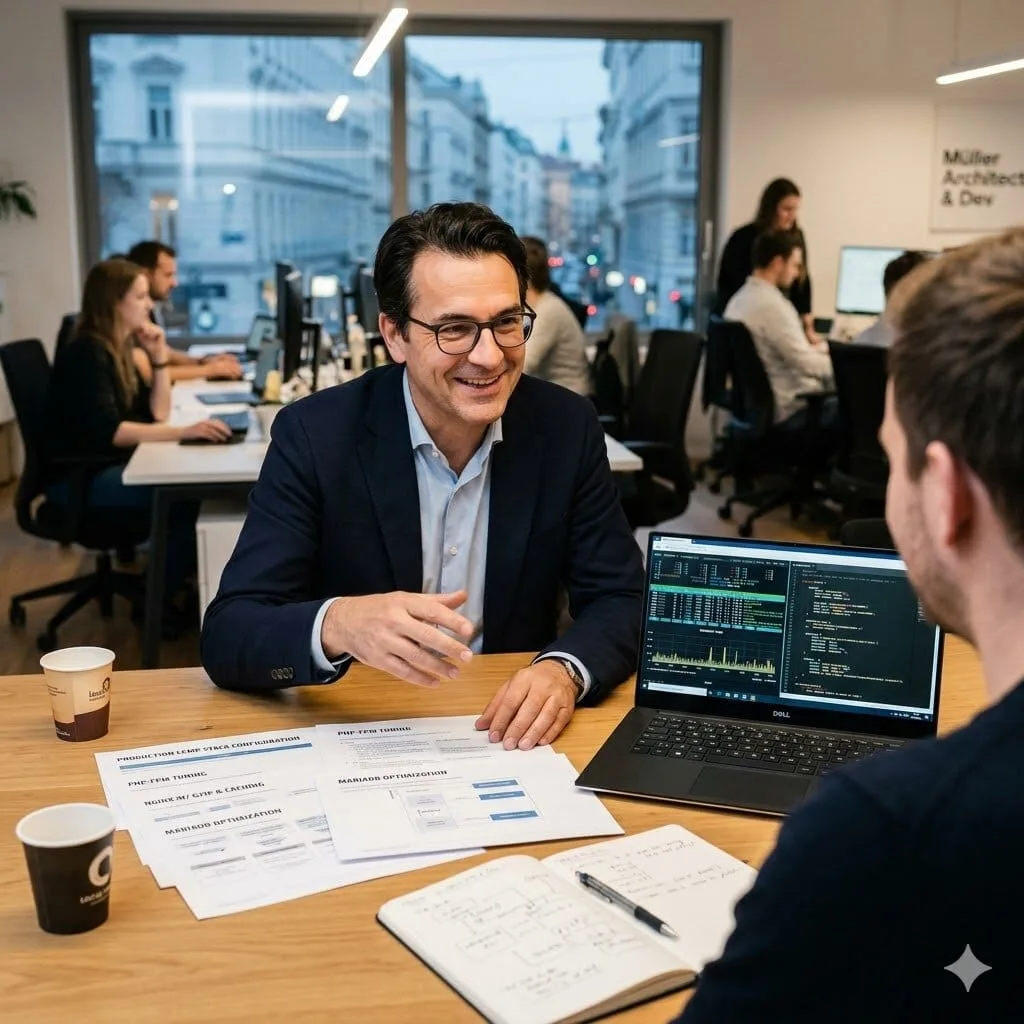
The Challenge: Stefan’s agency needed to deploy a LEMP stack for a new client project, but previous attempts by their developers had resulted in a working but poorly configured setup, default PHP memory limits, no query caching, and Nginx serving files without any gzip compression. The stack worked, but not well.
The vorza360 Solution: vorza360 deployed a production-grade LEMP stack with PHP-FPM pool settings tuned for the expected workload, MySQL buffer pool sized correctly for the server’s available memory, Nginx configured with gzip compression and browser caching, and Redis added for application-level caching.
The Result: The new application launched with page load times well under their target threshold. Stefan’s team received a properly commented configuration and understood what each setting did, meaning they could maintain and adapt the stack as the application evolved.
Nadia Al-Farsi (Oman)
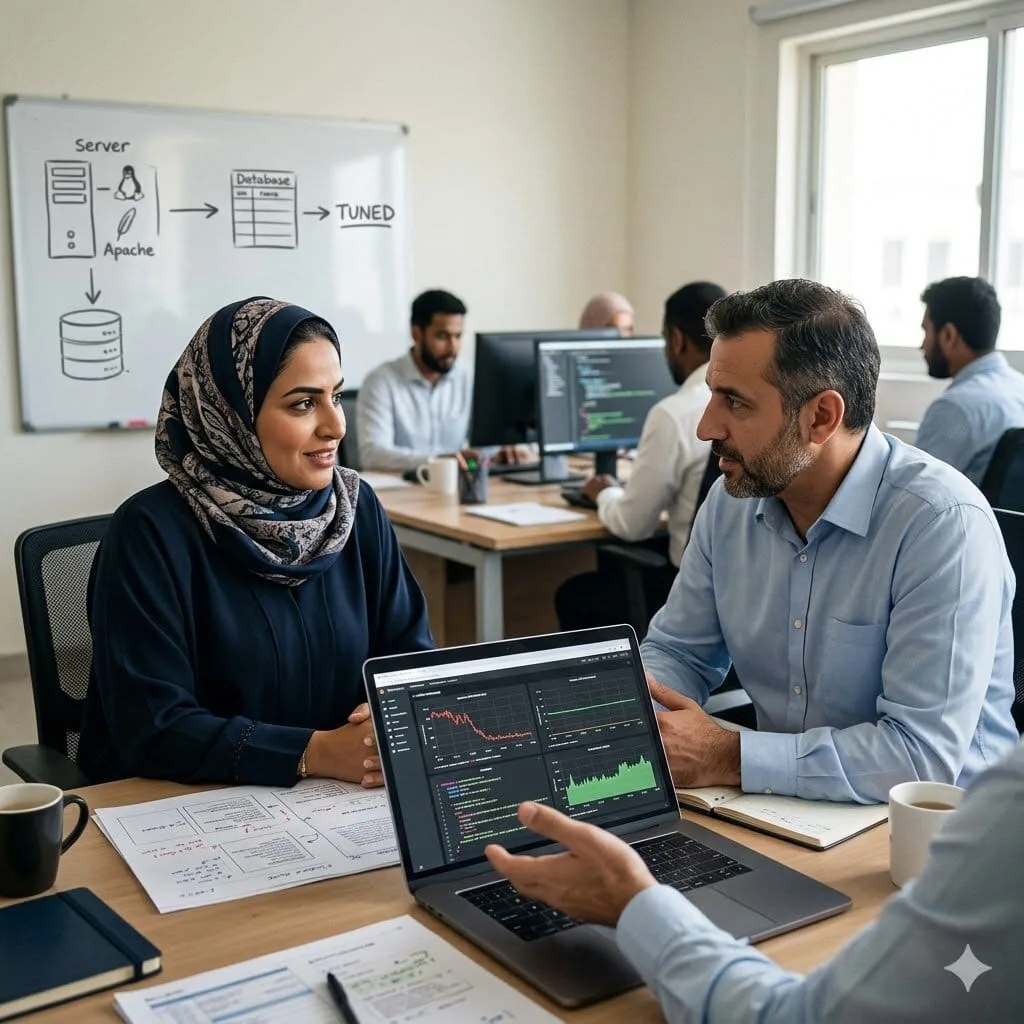
The Challenge: Nadia’s healthcare portal ran on a LAMP stack that had been set up by a contractor who was no longer available. The application was slow, the MySQL configuration had never been tuned, and nobody could explain why certain PHP extensions were installed, or whether they were all still needed.
The vorza360 Solution: vorza360 audited the existing LAMP stack, documented what was genuinely needed, removed unnecessary PHP extensions that were loading on every request, tuned the MySQL configuration for the actual workload, and added proper slow query logging to identify the database queries causing the worst performance issues.
The Result: Page load times improved noticeably within days of the MySQL tuning changes. The audit documentation Nadia received gave her IT team a clear understanding of the stack for the first time, and the slow query log revealed four database queries that were then fixed by her development team.
Mircea Stancu (Romania)
The Challenge: Mircea’s company needed to migrate a legacy PHP application from an aging server to a new Ubuntu environment without breaking the application. The application had specific PHP version requirements and depended on extensions that weren’t available in the default Ubuntu repositories.
The vorza360 Solution: vorza360 managed the full LAMP stack migration including PHP version management using ondrej/php PPA, sourced and compiled the required extensions, rebuilt the Apache virtual host configuration on the new server, and validated every feature of the application before the DNS cutover.
The Result: The application migrated without a single broken feature. Mircea’s team had been delaying the migration for over a year because of the perceived risk, vorza360 completed it in a planned weekend window with everything verified before they cut over.
Arjun Patel (India)
The Challenge: Arjun’s startup was launching its first web application and needed a LEMP stack set up quickly but correctly. Their developers were experienced with the application layer but had never set up a production Linux server before.
The vorza360 Solution: vorza360 deployed a complete LEMP stack including automated SSL certificate management, PHP-FPM with appropriate settings for their application framework, MySQL with a backup routine in place from day one, and a simple deployment workflow their developers could use to push updates.
The Result: The application launched on schedule with a production-grade server foundation. Arjun’s developers could deploy updates using a workflow they understood, and the SSL and backup configuration meant the basic infrastructure concerns were handled from the moment they went live.
Ingrid Larsson (Norway)
The Challenge: Ingrid’s non-profit organisation needed a reliable LAMP stack for their fundraising platform, but their IT budget was minimal. Previous attempts to self-manage the server had led to a PHP upgrade breaking the application, and they needed someone they could trust to get it right.
The vorza360 Solution: vorza360 deployed a stable LAMP stack pinned to the PHP version the application required, configured automated security updates for the OS packages while excluding PHP from uncontrolled updates, and set up daily database backups with off-site replication to a cloud storage provider.
The Result: The platform ran without interruption through their annual fundraising campaign, historically the period when technical problems had always seemed to strike. The controlled update policy meant no more accidental PHP upgrades breaking the application.
Kofi Asante (Ghana)
The Challenge: Kofi’s educational platform ran on a self-configured LAMP stack that was frequently running out of memory under load. Students would experience slow page loads during peak hours, and his team had no visibility into why, no monitoring, no slow query logging, no performance metrics of any kind.
The vorza360 Solution: vorza360 deployed monitoring to understand the actual resource usage patterns first, then tuned the MySQL and PHP-FPM configuration based on what the data showed. They added a basic Nginx caching layer in front of Apache for static content and implemented slow query logging to surface the database performance issues.
The Result: Peak-hour slowdowns were eliminated within two weeks of the changes being applied. Kofi’s team now had dashboards showing real-time resource usage, and the slow query log pointed directly to the database queries that were driving the memory pressure, which their developers then fixed.
vorza360’s Tech Edge
Linux Stack Architecture Planning
Web Server ↔ PHP Integration
PHP Runtime Configuration
+ 2
More
Database Connection Optimization
Stack Environment Isolation
vorza360’s Tech Edge
Linux Stack Architecture Planning
We design the structural “blueprint” of your server to ensure it can handle your specific business traffic.
Web Server ↔ PHP Integration
Our team expertly links your web server (Apache or Nginx) to PHP, so your website responds to customers instantly.
PHP Runtime Configuration
We fine-tune how your website’s code runs, reducing memory waste and speeding up every page load.
Database Connection Optimization
We optimize the “conversation” between your website and its data, ensuring information is pulled and saved without delays.
Stack Environment Isolation
We keep your different web projects in separate “containers” so a glitch in one site never affects your other business tools.
How we do it
We treat every lamp stack deployment as a custom build, focused on your business goals.
Creative Approaches
We go beyond basic installs by finding unique ways to deploy local lamp stack environments that perfectly mirror your live cloud servers. This creative “mirroring” allows your team to test new features safely in a local office setting before they go live to the world.
Insightful Strategies
Our strategy involves choosing the right “engine” for your needs. We provide insightful guidance on whether to deploy mail servers on LEMP stack for high-speed delivery or use traditional methods for maximum compatibility. We look at your future growth to decide if we should deploy LAMP stack on the kubernetes cluster for massive scalability.
Tailored Solutions
Every cloud is different. We provide tailored services to deploy a simple LAMP stack to AWS or help you deploy WordPress on Azure in lamp stack. We can even help you use cloud marketplace to deploy a LAMP stack and then step in to provide the professional management and security hardening that automated tools often miss.
Creative Approaches
We go beyond basic installs by finding unique ways to deploy local lamp stack environments that perfectly mirror your live cloud servers. This creative “mirroring” allows your team to test new features safely in a local office setting before they go live to the world.
Insightful Strategies
Our strategy involves choosing the right “engine” for your needs. We provide insightful guidance on whether to deploy mail servers on LEMP stack for high-speed delivery or use traditional methods for maximum compatibility. We look at your future growth to decide if we should deploy LAMP stack on the kubernetes cluster for massive scalability.
Tailored Solutions
Every cloud is different. We provide tailored services to deploy a simple LAMP stack to AWS or help you deploy WordPress on Azure in lamp stack. We can even help you use cloud marketplace to deploy a LAMP stack and then step in to provide the professional management and security hardening that automated tools often miss.
Our Service Cycle
vorza360 follows a clear, professional path to give you a full lamp deployment stack that lasts.
Step 1
Requirement Mapping
Step 2
Environment Preparation
Step 3
Core Installation
Step 4
Security Hardening
Step 5
Performance Testing
Step 6
Ongoing Management
Step 1
Requirement Mapping
We discuss your app’s needs to choose between the speed of LEMP or the flexibility of LAMP.
Step 2
Environment Preparation
Our team sets up the base Linux system, whether you want to deploy local LAMP stack MAC or a cloud server.
Step 3
Core Installation
We install the web server, database, and PHP, ensuring every piece is the latest, safest version.
Step 4
Security Hardening
We lock down the “back doors,” add SSL certificates, and set up firewalls to protect your data.
Step 5
Performance Testing
We run speed tests to ensure your LAMP stack deployment is working at its absolute peak.
Step 6
Ongoing Management
vorza360 stays with you, providing updates and human support to keep your web stack healthy.
Why Choose vorza360 for This Service?
Your web stack is the engine of your online business. At vorza360, we ensure that the engine never stalls.
Multi-Cloud Experts
Whether you need to deploy a simple LAMP stack to AWS or a custom setup on Azure, we have the experience to make it work perfectly.
Reliability Over Products
We don’t just sell you a setup; we provide a service. We take ownership of your server’s health so you can focus on your business.
Simple, Human Support
We explain your LAMP and LEMP stack deployment in easy words. If you have a question about your server, a real person is here to give you a clear answer.
Here is what our Clients are saying About us
Hiroshi Tanaka (Japan)
Our development team needed a fully working LEMP stack deployed consistently across multiple Ubuntu servers. vorza360 handled the entire deployment, configured PHP-FPM correctly, and made sure every component was tuned to work together. The stack has been running without issues since day one.
Amira Benali (Algeria)
We’d attempted our own LAMP stack setup three times and kept running into dependency conflicts and misconfigured services. vorza360 came in, cleared the mess, and deployed a clean stack from scratch. The ‘clean-slate deployment’ they delivered was exactly what we needed to finally move forward.
Dragoș Ionescu (Romania)
vorza360 deployed a LEMP stack for our e-commerce platform and optimised every layer specifically for our workload. Database queries are faster, PHP response times improved, and Nginx is handling our traffic smoothly. The performance difference compared to our previous setup is significant.
Zanele Dlamini (South Africa)
Setting up a LAMP stack for our internal tools sounded simple until we tried it ourselves. vorza360 handled everything, Apache, MySQL, PHP, configured correctly and tested end-to-end before handing it over. They even documented the setup in a way our team could actually follow.
Emre Yıldız (Turkey)
vorza360 set up a LEMP stack optimised for our WordPress multi-site installation. They configured object caching, tuned the database, and set up proper PHP-FPM pools. Our site now handles three times the traffic it did before without breaking a sweat.
Nkechi Obi (Nigeria)
We needed a LAMP stack deployed on a tight timeline for a client launch. vorza360 delivered a fully configured, tested environment in under a day. The ‘launch-ready stack’ they built meant we could go straight to deployment without any last-minute configuration headaches.
More about Ubuntu
Ubuntu Server Setup & Configuration
Get your business online quickly and securely with vorza360’s expert Ubuntu server setup…
Got questions? We’ve got answers. Find everything you need to know about using our platform, plans, and features
What is a LAMP or LEMP stack and what does vorza360 deploy for web application hosting?
A LAMP stack is a set of open-source software components used together to host dynamic web applications on Linux: Linux (the operating system, Ubuntu in our case), Apache (the web server), MySQL or MariaDB (the relational database), and PHP (the server-side scripting language). A LEMP stack replaces Apache with Nginx (pronounced Engine-X, hence the E), providing better performance for high-concurrency workloads. Both stacks are the foundational hosting environment for the world’s most widely used web applications including WordPress, Drupal, Joomla, Magento, and custom PHP applications. vorza360 deploys LAMP stacks when the application requires Apache-specific features or .htaccess support, and LEMP stacks when performance and scalability are the priority. We configure all components to work together correctly and securely, producing a web application hosting environment that is optimized for your specific application and expected traffic volume.
How does vorza360 configure the MySQL or MariaDB component of a LAMP/LEMP stack?
The database component is typically the performance bottleneck in a web application stack, and its configuration has a profound impact on application response times under load. vorza360 configures MySQL or MariaDB on Ubuntu by running mysql_secure_installation to remove default security risks (anonymous users, test databases, remote root login), creating application-specific database users with minimum necessary privileges rather than using root for application connections, tuning the InnoDB buffer pool size (the most impactful single configuration change, typically set to 70 to 80 percent of available RAM on a dedicated database server), configuring the query cache appropriately for the application’s read/write ratio, setting the maximum connections parameter to match the expected application connection pool size, enabling the slow query log for ongoing performance monitoring, configuring appropriate table cache sizes, and enabling binary logging if replication or point-in-time recovery is required.
How does vorza360 configure PHP for optimal security and performance in a LAMP/LEMP stack?
PHP configuration affects both the security and performance of every web application running on the stack. vorza360 configures PHP for production LAMP/LEMP deployments by selecting the appropriate PHP version for the application and installing it via the Ondrej/PHP PPA for the latest supported releases, configuring PHP-FPM (FastCGI Process Manager) as the process management model, which provides better performance and isolation than mod_php by running PHP as a separate service with configurable worker pools. We configure PHP-FPM pool settings (pm.max_children, pm.start_servers, pm.min_spare_servers, pm.max_spare_servers) to match available memory and expected concurrent request volumes. We apply security hardening in php.ini: disabling dangerous functions (exec, system, shell_exec where not required by the application), hiding the PHP version from headers (expose_php = Off), setting appropriate upload and execution time limits, enabling OPcache with tuned cache memory and validate_timestamps settings for production performance, and configuring open_basedir restrictions where feasible.
How does vorza360 deploy a WordPress site on an optimized Ubuntu LEMP stack?
WordPress deployment on an optimized Ubuntu LEMP stack requires correct configuration of all four stack components working together, plus WordPress-specific optimizations. vorza360 deploys WordPress on Ubuntu LEMP by configuring the Nginx server block with WordPress-specific rules: the try_files directive for clean URL handling, fastcgi_pass directives routing PHP requests to the correct PHP-FPM pool, security rules blocking access to sensitive WordPress files (wp-config.php, xmlrpc.php, wp-admin accessible only from authorized IPs), and Nginx FastCGI cache configuration for full-page caching of non-logged-in visitor requests. We create a dedicated MySQL database and user for WordPress, install WordPress using WP-CLI for repeatable automated deployment, configure wp-config.php with security keys and correct database credentials, configure WordPress salts from the API, apply file permission hardening (644 for files, 755 for directories, 600 for wp-config.php), and install and configure a WordPress security plugin and caching plugin that complement the Nginx-level FastCGI cache.
How does vorza360 scale a LAMP/LEMP stack for higher traffic on Ubuntu?
A single-server LAMP/LEMP stack has inherent scaling limits, the web server, application logic, and database compete for the same CPU and memory. vorza360 scales LAMP/LEMP stacks for higher traffic through a phased approach: vertical scaling first (increasing the server’s CPU and RAM resources to extend single-server capacity), then horizontal scaling for applications that genuinely require it. Horizontal scaling involves separating the database to a dedicated server (removing database load from the web server’s resources), implementing multiple web/application servers behind a load balancer (Nginx upstream or HAProxy), configuring a centralized session storage using Redis or Memcached (allowing any web server to handle any user’s session), implementing a read replica for the database to offload read queries from the write master, configuring a CDN in front of the stack for global static asset delivery and traffic absorption, and implementing Redis object caching for the application layer (dramatically reducing database query load for database-heavy applications like WordPress with WP Redis plugin).