vorza360 delivers full IoT and smart device network integration services to connect all your smart devices securely and reliably. We build a strong IoT networking foundation that lets your sensors, equipment, and devices talk to each other and your main systems.
The Challenge: Henrik’s cold chain logistics company operated hundreds of refrigerated containers, each needing to transmit temperature sensor data in real time to their operations platform. The sensors used various connectivity protocols, the data was arriving inconsistently, and there was no unified platform to aggregate and act on it. Temperature excursions were sometimes identified too late to prevent product loss.
The vorza360 Solution: We designed and implemented an IoT network integration platform that connected all the container sensors through a unified data ingestion layer, normalising the different protocols into a consistent data format. We implemented real-time alerting for temperature threshold breaches, built historical data storage with audit trail capability for regulatory compliance, and integrated the platform with the operations system so alerts triggered workflow responses automatically.
The Result: Temperature excursion alerts became reliable and timely, allowing Henrik’s operations team to respond to developing problems before they caused product loss. The audit trail capability satisfied the regulatory requirement for cold chain documentation that his food industry clients required. He described the transformation from inconsistent sensor data to reliable, actionable real-time visibility as the improvement that most directly protected his business’s core value proposition.
Amara Kouyaté (Ivory Coast)
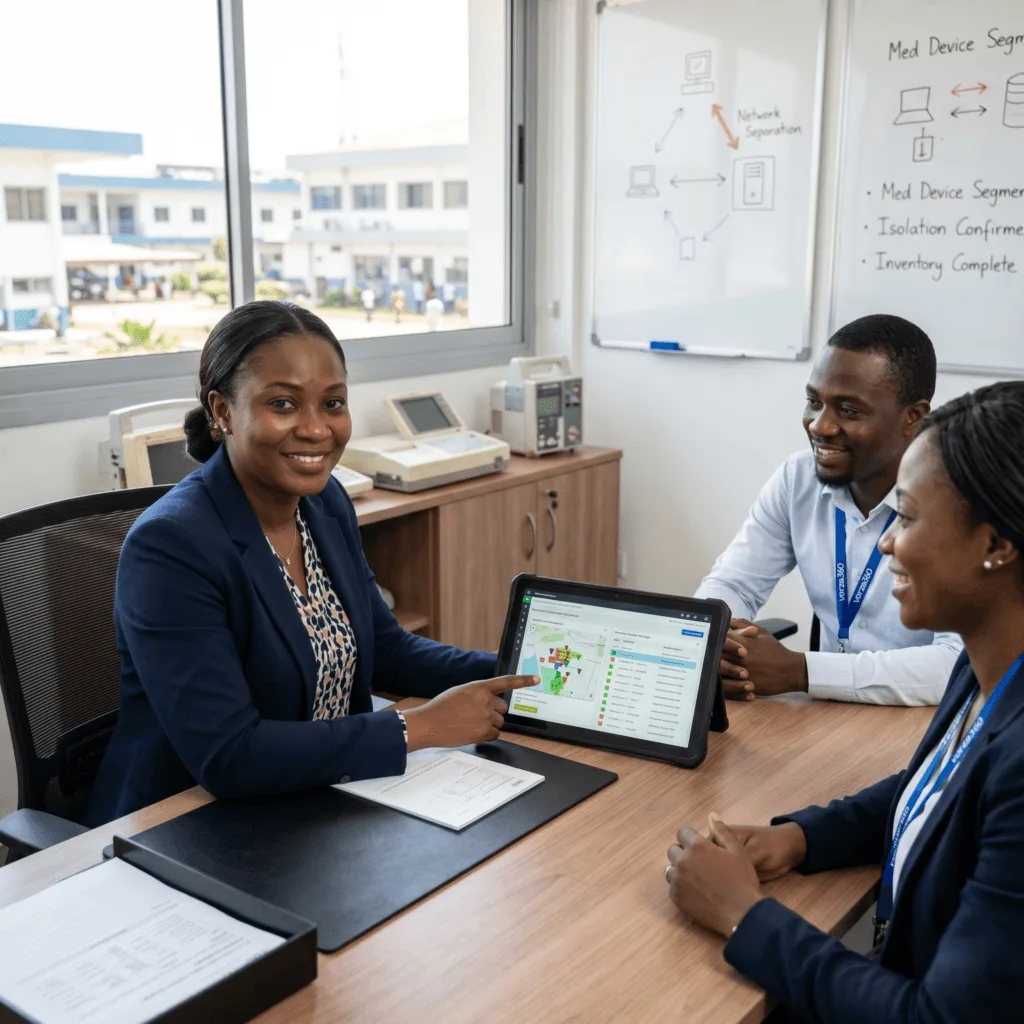
The Challenge: Amara’s hospital had installed smart medical equipment throughout the wards over several years, but the devices hadn’t been properly integrated into the network. Some were on the general staff network, some on the guest network, and some had been connected to ad-hoc hotspots when the main network couldn’t support them. A medical device security review had flagged the situation as unacceptable from both a security and reliability perspective.
The vorza360 Solution: We designed a dedicated medical device network segment with strict isolation from the clinical and administrative networks, migrated all medical devices onto the dedicated segment with appropriate access controls at the boundary, implemented device inventory management so every connected device was documented and monitored, and established a onboarding process for new medical devices that ensured they would always join the correct network.
The Result: Every medical device in the hospital was properly isolated and documented for the first time. The medical device security review was repeated following the remediation and confirmed the situation had been resolved. The device inventory management gave Amara’s biomedical engineering team a complete, current picture of connected medical equipment that they used for maintenance scheduling and replacement planning.
Ryo Tanaka (Japan)
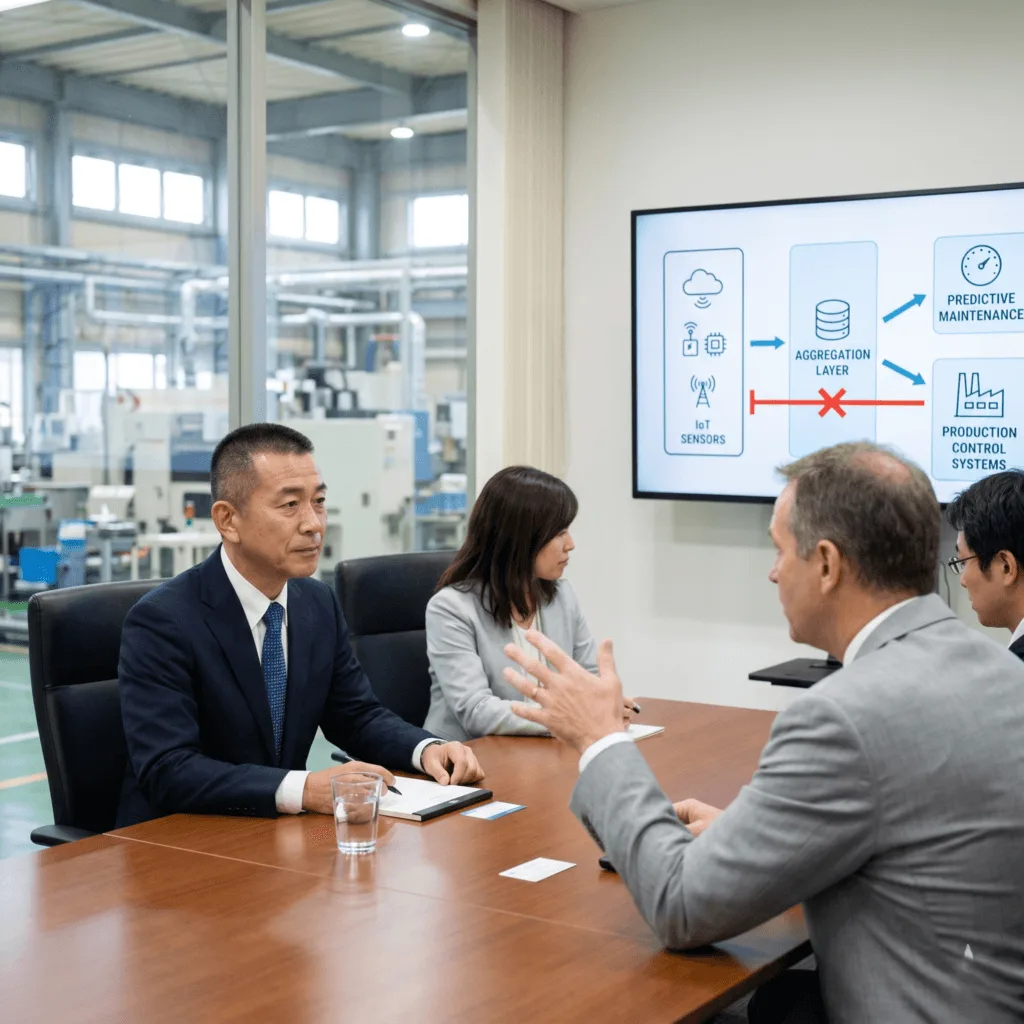
The Challenge: Ryo’s smart manufacturing plant had installed industrial IoT sensors on production machinery to feed a predictive maintenance platform, but the sensors were connecting through the production control network in a way that the IT security team considered unacceptable. The convergence of IT and OT networks had happened without proper security architecture, and the risk of the IoT devices being used as an attack path into production systems was genuine.
The vorza360 Solution: We designed a network segmentation architecture that gave the IoT sensors their own isolated network segment, separate from both the production control systems and the corporate IT network, with a data aggregation layer that extracted the sensor telemetry and forwarded it to the predictive maintenance platform without any direct network path between the IoT devices and the production control systems.
The Result: Ryo’s IT security team accepted the IoT network architecture as meeting their requirements for the first time. The predictive maintenance platform continued to receive the sensor data it needed, and the production control systems were properly isolated from the IoT devices. The architecture became the template for subsequent IoT deployments at his other manufacturing facilities.
Fatou Baldé (Senegal)
The Challenge: Fatou’s smart building management company had deployed environmental sensors, access control systems, and HVAC controllers across a multi-tenant commercial building, but the devices were all on a flat network shared with tenant systems. One tenant’s IT team had raised concerns about the shared network, and an attempted configuration change to an HVAC controller had exposed that any device on the network could reach it.
The vorza360 Solution: We designed and implemented a segmented IoT network architecture that placed all building management devices on a dedicated network isolated from tenant networks. We implemented a building management gateway that provided authorised access to device configuration and monitoring while preventing direct device access from tenant networks. We also deployed device inventory management and anomaly detection for the building management network.
The Result: The tenant concern was resolved by the network segmentation, which was documented and shared with tenant IT teams. The HVAC controller access vulnerability was closed, and the building management team had a clear, defensible architecture they could describe to tenants who raised similar questions in future. Fatou’s company used the segmentation design as the standard for all subsequent building management deployments.
Pedro Almeida (Brazil)
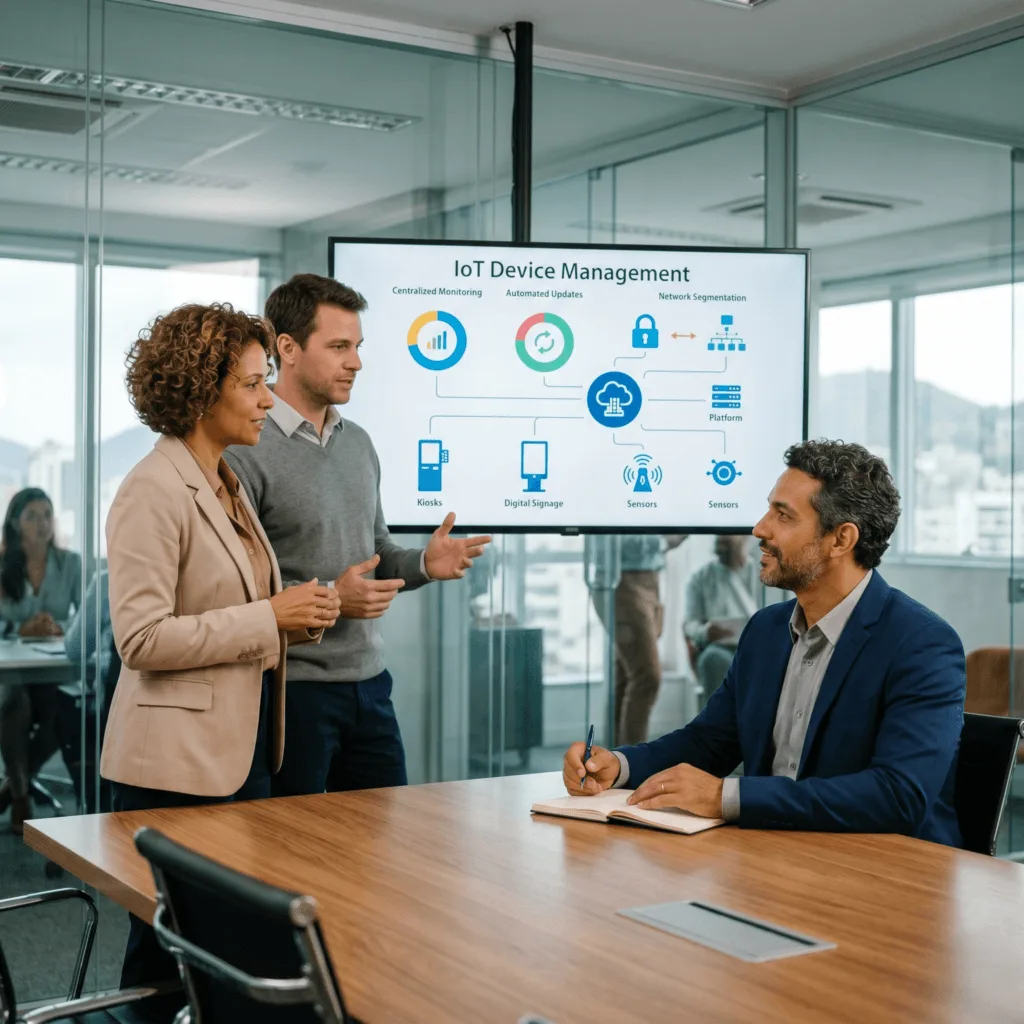
The Challenge: Pedro’s smart retail chain had deployed self-checkout kiosks, digital signage systems, and customer footfall sensors across forty-two stores, but none of the IoT device categories had been considered when the store networks were designed. Device firmware updates were being applied manually, device failures were discovered reactively when staff noticed them, and there was no centralised management of the entire IoT estate.
The vorza360 Solution: We implemented an IoT device management platform that provided centralised visibility across all device categories in all forty-two stores, automated firmware update management that could push updates to all devices of a given type simultaneously, health monitoring with alerting when devices went offline, and a structured network segmentation that placed each device category in an appropriate network zone.
The Result: The manual firmware update process that had been consuming significant time from Pedro’s IT team was automated, reducing the effort from days per update cycle to hours. Device failures were detected and reported automatically rather than discovered when customers noticed them. The centralised management gave Pedro’s IT team a complete picture of his IoT estate for the first time, which the retail operations team described as transforming device reliability from a recurring issue to a managed baseline.
Anika Patel (Singapore)
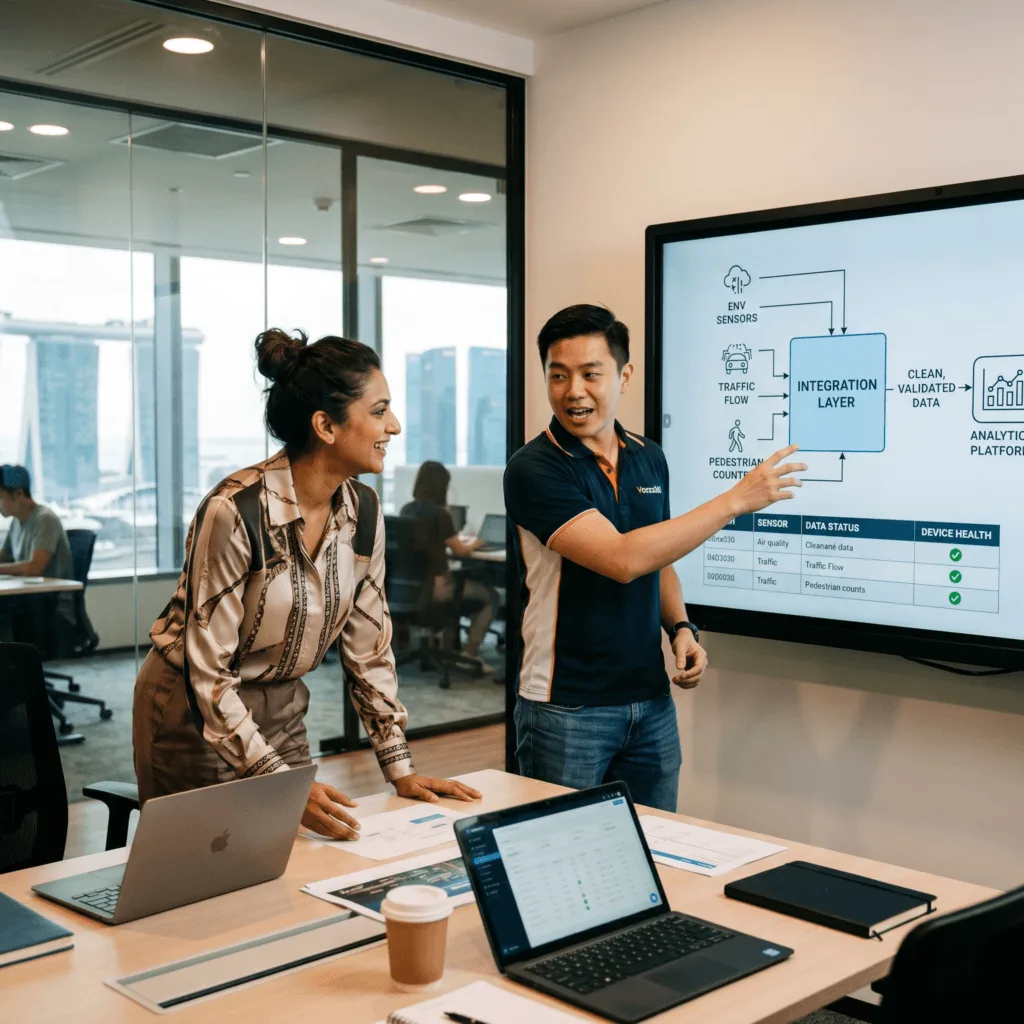
The Challenge: Anika’s smart city pilot project had connected environmental monitoring sensors, traffic flow sensors, and pedestrian counting systems to a city network, but the diversity of devices and communication protocols had created an integration challenge. Data from different device types was arriving through different paths, in different formats, and at different reliability levels, making the analytics platform that depended on it difficult to operate.
The vorza360 Solution: We designed and implemented a unified IoT integration layer that accepted data from all device types regardless of their communication protocol, normalised the data into a consistent format, and forwarded it to the analytics platform through a single, reliable data pipeline. We implemented device health monitoring across all device types and data quality validation that flagged suspect readings rather than allowing them to corrupt the analytics.
The Result: The analytics platform received consistent, validated data from all device types for the first time. Data quality issues that had been causing incorrect readings in the analytics were eliminated by the validation layer. Anika’s project team described the integration layer as the foundation that allowed the rest of the smart city project to function as intended, the analytics capabilities had been built correctly, but they needed reliable data input to deliver on their promise.
How we do it
We make connecting all your smart devices easy and secure, turning your network into an intelligent system.
Simple, Smart Technology
We use the best core network services for IoT devices to handle all the connections. This tech is designed to manage many devices talking at once, ensuring your system is stable and easy to scale up.
Intelligent Strategies
We look at all your devices and figure out the safest and fastest way for them to connect to your network. We design the best setup for your IoT network integration, especially for things like wireless sensor networks in IoT.
Custom Solutions
Our service builds an integrated IoT network just for your business. We customize the security and data rules to match your needs perfectly, making sure all your smart devices work together smoothly and safely.
Simple, Smart Technology
We use the best core network services for IoT devices to handle all the connections. This tech is designed to manage many devices talking at once, ensuring your system is stable and easy to scale up.
Intelligent Strategies
We look at all your devices and figure out the safest and fastest way for them to connect to your network. We design the best setup for your IoT network integration, especially for things like wireless sensor networks in IoT.
Custom Solutions
Our service builds an integrated IoT network just for your business. We customize the security and data rules to match your needs perfectly, making sure all your smart devices work together smoothly and safely.
Tools
Key Tools vorza360 Offers
IoT Device Management Platform
A central dashboard to monitor the status, health, and location of every smart device on your network.
Over-the-Air (OTA) Updater
A tool that automatically sends security updates and new features to all your IoT and smart device networks without needing manual work.
Security Policy Enforcer
Software that makes sure every new device connecting to the integrated IoT network follows all your security rules immediately.
Data Ingestion Pipeline
A fast, secure system that takes data from thousands of sensors and prepares it for analysis or storage.
Multiple Platform Support
We ensure your IoT solution works seamlessly across all necessary environments.
Public Cloud Backends
Connects sensor data directly to major platforms (AWS IoT, Azure IoT Hub, Google Cloud IoT).
Edge Computing Devices
Supports processing and filtering data directly on local, low-power devices before sending it to the cloud.
Multiple Connectivity Types
Works with Wi-Fi, Bluetooth, LoRaWAN, and cellular connections (best IoT SIM with multi network support).
Legacy System Integration
Connects new smart devices with your older, existing operational technology (OT) systems.
Operating System Agnostic
Runs on Linux, Windows IoT, and real-time operating systems (RTOS) used by small devices.
Centralized Web Interface
Provides one secure, browser-based portal to manage all IoT networking and data flow.
Public Cloud Backends
Connects sensor data directly to major platforms (AWS IoT, Azure IoT Hub, Google Cloud IoT).
Edge Computing Devices
Supports processing and filtering data directly on local, low-power devices before sending it to the cloud.
Multiple Connectivity Types
Works with Wi-Fi, Bluetooth, LoRaWAN, and cellular connections (best IoT SIM with multi network support).
Legacy System Integration
Connects new smart devices with your older, existing operational technology (OT) systems.
Operating System Agnostic
Runs on Linux, Windows IoT, and real-time operating systems (RTOS) used by small devices.
Centralized Web Interface
Provides one secure, browser-based portal to manage all IoT networking and data flow.
Key Framework & Technology Support
MQTT (Message Queuing Telemetry Transport)
Protocol used for lightweight, reliable messaging between small sensors and the cloud.
CoAP (Constrained Application Protocol)
Web transfer protocol used for resource-constrained devices and networks.
Zigbee / Z-Wave
Support for home automation and low-power wireless communication standards.
LoRaWAN
Framework used for long-range, low-power IoT networking, often covering wide areas.
AWS IoT Greengrass
Integration for local compute, messaging, data caching, and sync capabilities for connected devices.
EdgeX Foundry
Open-source framework for standardizing connectivity and device management at the network edge.
Containerization (Docker/K8s)
Using containers to securely deploy and manage application code on smart devices.
Digital Twin Technology
Framework for creating virtual models of physical devices for testing and predictive maintenance.
Custom Services We Serve
vorza360 is a creative digital agency that uses expert skills to meet your business needs and ensure customer satisfaction. We work across many different sectors to help brands grow and succeed online.
Fashion & Apparel
Food & Grocery
Retail
FMCG
Real Estate
Construction
Hotel
Healthcare
Telecom
Fintech
Manufacturing
Automotive
Our IoT Integration service Life Cycle
We follow a clear cycle to securely deploy, integrate, and optimize your entire smart device network.
Step 1
Discovery & Strategy
Step 2
Device and Gateway Setup
Step 3
Network Integration & Connectivity
Step 4
Security Hardening
Step 5
Testing & Optimization
Step 6
Monitor & Scale
Step 1
Discovery & Strategy
We check your business goals and current equipment, then design a comprehensive IoT network integration strategy.
Step 2
Device and Gateway Setup
We select and install the sensors and core network devices (best core network solutions for IoT) needed to collect data
Step 3
Network Integration & Connectivity
We connect all devices to your existing network and the cloud using secure, reliable protocols.
Step 4
Security Hardening
We apply strong authentication and encryption across every device and connection point to protect your data.
Step 5
Testing & Optimization
We check all IoT wireless sensor networks for coverage and speed, tuning the system for maximum data quality and performance.
Step 6
Monitor & Scale
We set up continuous monitoring for all devices and create simple pathways to easily add thousands of new devices later.
Here is what our Clients are saying About us
Erik Lindberg (Sweden)
Integrating our IoT devices into our corporate network without creating security risks required careful network design. vorza360 created an isolated IoT network segment with controlled gateways to our corporate systems. We have the integration we need without the security exposure.
Tariq Al-Zahrani (UAE)
vorza360 designed and deployed the network infrastructure for our smart building system integrating access control, HVAC, lighting, and security cameras on a unified network with appropriate segmentation between systems.
Mihai Florescu (Romania)
Our factory floor IoT sensors were on the same network as our corporate systems creating both security and reliability risks. vorza360 segmented our OT and IT networks correctly while maintaining the data flows our analytics systems require.
Vikram Kapoor (India)
vorza360 integrated our fleet of IoT environmental monitoring devices into our network infrastructure with secure provisioning, centralised management, and the data pipeline to our analytics platform. End-to-end IoT implementation from device to dashboard.
Huang Wei (China)
vorza360 designed the network architecture for our smart factory with deterministic network segments for time-sensitive industrial control systems and separate segments for monitoring and management traffic. Industrial network design that understands the real-time requirements of manufacturing.
Kwame Asante (Ghana)
vorza360 integrated our smart metering infrastructure into our network with the security controls and data collection reliability our utility operations require. IoT at scale implemented correctly from the network layer up.
More about Networking
SD-WAN Solutions
vorza360 delivers modern SD-WAN solutions that completely change how your wide…
Got questions? We’ve got answers. Find everything you need to know about using our platform, plans, and features
What IoT and smart device network integration services does vorza360 provide?
vorza360 delivers end-to-end IoT & Smart Device Network Integration through a structured six-stage lifecycle: Discovery & Strategy (assessing your business goals, existing infrastructure, and IoT requirements), Device and Gateway Setup (selecting and installing sensors, actuators, and edge gateways), Network Integration & Connectivity (connecting all devices to your existing network and cloud backends using appropriate protocols, MQTT, CoAP, LoRaWAN, Zigbee, or cellular), Security Hardening (implementing authentication, encryption, and network segmentation for every device), Testing & Optimization (validating coverage, data quality, and system performance), and Monitor & Scale (continuous device health monitoring and a clear pathway to add thousands more devices without architectural rework). All IoT deployments integrate with major cloud IoT platforms including AWS IoT, Azure IoT Hub, and Google Cloud IoT.
How does vorza360 secure IoT devices on a corporate network?
IoT devices are one of the most significant and often overlooked security risks on corporate networks, they frequently run outdated firmware, use weak default credentials, and cannot run traditional endpoint security software. vorza360 addresses IoT security through network-level controls: dedicated IoT VLANs that completely isolate smart devices from corporate computers and servers (so a compromised IP camera cannot reach your file servers), a Security Policy Enforcer that validates every new device against defined security standards before it is permitted to communicate on the network, mandatory credential rotation and firmware updates via an Over-the-Air (OTA) Updater, and continuous monitoring using an IoT Device Management Platform that detects anomalous device behavior (unexpected traffic patterns, unusual connection attempts) and alerts immediately.
What communication protocols does vorza360 use for IoT integration, and how are they chosen?
vorza360 selects IoT communication protocols based on the specific requirements of each device category and use case: MQTT is used for lightweight, reliable messaging from sensors and devices to cloud backends over standard IP networks (ideal for most industrial and commercial IoT applications); CoAP is used for resource-constrained devices on low-bandwidth networks; Zigbee and Z-Wave are used for short-range, low-power mesh networks in smart building environments; LoRaWAN is selected for long-range, low-power wide-area coverage (sensors spread across a large campus, agricultural land, or remote locations where Wi-Fi and cellular are impractical); and cellular (4G/5G with best IoT SIM multi-network support) is used for mobile or geographically isolated devices. The right choice depends on range, power constraints, data rate requirements, and existing infrastructure.
Can vorza360 integrate new IoT devices with our existing legacy operational technology (OT) systems?
Yes. Legacy System Integration is a core capability of vorza360’s IoT integration service. Many manufacturing, logistics, and facilities management organizations have significant investments in older operational technology, SCADA systems, PLCs, building management systems, industrial sensors, that predate modern IP networking. vorza360 uses protocol translation gateways and middleware layers to bridge these legacy OT systems with modern IoT platforms and cloud analytics environments, allowing you to extract value from existing equipment investments without replacing them. We design this OT/IT convergence with careful attention to security, ensuring the integration does not expose previously air-gapped critical systems to network-borne threats, and with operational continuity as a primary constraint throughout the implementation.
How does vorza360 scale an IoT deployment from a pilot to thousands of devices?
vorza360 designs IoT architectures with massive scale as an explicit requirement from day one, even for initial pilot deployments. The Monitor & Scale phase of our IoT lifecycle establishes the infrastructure foundations needed for scale: a cloud IoT backend (AWS IoT Core, Azure IoT Hub) that can handle millions of concurrent device connections with automatic scaling, device provisioning automation (so new devices are onboarded to the network automatically rather than manually configured one by one), a hierarchical edge computing architecture that processes and filters data locally on gateway devices before sending it to the cloud (reducing bandwidth costs and cloud processing costs as device counts grow), and an IoT Device Management Platform that manages thousands of devices as efficiently as ten. Scaling from a 50-device pilot to a 10,000-device production deployment becomes an operational exercise rather than an architectural one.